從來就不是很善於撰寫文字.腦袋一堆想法飛來飛去,要坐下來寫就開始struggle.
今年過得還算精彩,但現在或許這不是個適合撰寫的時間點.只是突然想要寫.
去年11月開始參加野草苺,沒日沒夜地被某種熱情所盤據.不斷地看BBS上的PO文,幫忙收捐款,演行動劇,參加在場上自焚的劉老先生的公祭,跟警察在總統府前爭辯,寫海報,戴孝衣,...翹了很多課,學校跟補習班.但我認識了一堆有趣有行動力,有創意,自我挖掘與挑戰的人們,而不是只想鄉愿的走社會期待道路的競爭力崇拜者.
在某個場合中,我順利的讓國際行動組成立.CYRIX很恰好地在那個時點失業,扛下了所有的聯繫工作.但我,好像只是稍微有一點點語言的優勢,就出了點鋒頭.我們出席了美國自由之家在台北的年度全球民主報告.也接受了幾個外國人/媒體的訪問.由於Lynn Miles的引鑑, 在JEROME KEATING的早餐會中跟ROBIN打了照面.....
大六上學期就這樣結束.
大六下學期開始.
我很白痴地錯過了人權學程碩士班的報名.或許是因為我潛意識中極欲擺脫唸書的生活.即便我一直都不是個好學生.
補習班的課程一直讓我厭煩,坐在冷氣房中聽幾個小時的課,打瞌睡,醒來又聽到一堆構成要件與法條號碼飛來飛去.
去年的暑假好不容易找到理由讓自己覺得想去要考試.但是補習班生活實在讓我噁心.
大約四月的時候發現某基金會提供到國外NGO工作的機會,花了一些時間準備資料,請黃默老師跟欣怡幫我寫推薦信等等.
一個多月後的第一階段面試後又一個月,發現我沒有錄取.
性別心理學的課非常有趣,我們談身體,性,性工作者,LGBT的認同,性別刻版印象.
另一堂課:體制暴力與個體.老師是台北監獄強暴犯的心理治療師,從課堂上聽到犯人,病人,然後自以為好像更知道到底何為人.
然後畢業.
我終於知道甚饃叫做有桃花.這一年內開始有好幾個人叫我美女(一整個感覺怪異),有幾個曖昧關係.
一個有趣的傢伙,幾個感覺很不錯的對話跟相處與碰觸後,開始進入一段真正的關係.
我已經放棄要去考司法考試.補習跟所有的法律讓我很喘不過氣.研究所,國外工作跟國家考試都從當前的人生計畫剃除後,孑然一身一片空白,很自由也相當慌張.
一邊寫履歷表一邊搜尋各種可以參加的活動.一個半月內我分別參加了地球公民協會,圖博之友會 跟青年勞動九五聯盟的營隊.
WALLE讓我開始進行某些探險-我以前一直想要進行但一直找不到對的人跟臨門一腳動機去做的事.我終於真正走出台北.
從台中騎機車一路到高雄去參加環團的營隊,又再度碰到Robin.聊聊近況後幾個禮拜,我進入綠黨工作.
正式上工前,WALLE跟我花一個禮拜用機車跑了半個台灣.開始產生一些摩擦,但也更瞭解彼此.那個週末莫拉克來襲,我們冒著強風回到台中,然後發現我們幾天前才剛經過的美景通通都泡在水裡.
然後開始工作.
第一個月:一頭霧水搞不清楚狀況且不知道如何求助的我.
第二個月:想辦法把自己的定位找出來.很慶幸有KELI,KARL,FRANK, ROBIN還有WALLE的持續鼓勵,讓我在一片迷霧中還有點動力想辦法找出路來.
-我被民主基金會邀請去韓國參加亞洲民主論壇.正式會議之外,跟一群亞洲各國的青年運動者有許多有趣的交流.
好不容易可以出去玩的一個晚上,在東大門逛到半夜三點,一整個快掛點...
第三個月:好像越來越瞭解狀況,但是發現責任越來越多.很多一頭霧水到現在仍是一頭霧水.
-去澳洲參加綠色新政會議期間,又獲得一些動力賦予自己一些更積極的角色.
回來之後,過了個很長的週末..但其實每天都還因為工作的細節安排搞得頭很炸.但至少網站看起來相當不賴了.
-在台北,APGN的會議上的一片混亂讓仍讓我有些無所適從.
-幾個小時以前,有個工作壓力大的要死的人每句話中都帶著刺的微笑回答我的一些疑問...
然後我在直走咖啡,看到一些有些認識的面孔在這裡聊天談笑喝飲料.
我覺得自己似乎與世隔絕了好一陣子.也不過是一年的時間...

2009-11-04
2009-08-14
[連署]釋放被囚禁的中國夢:中國維權律師許志永.
帶許志永和莊璐回家 連署書 2009.8.14
「讓我們真誠對待我們的法律,我們的同胞,我們的政府、我們的民族的過去。不管歷史曾經給多少人造成了傷害,不管你如何懷疑眼前的現實,不管未來面臨多少艱辛。讓我們行動起來吧!有了行動才有進步的可能。」~許志永
我們呼籲中國政府應盡快釋放許志永與莊璐
在北京提供法律援助的非政府組織公盟法律研究中心(簡稱公盟),其負責人許志永與工作人員莊璐在2009年7月29日(三)清晨五點被北京公安國保人員以「涉嫌偷稅」罪名帶走,目前羈押於北京第一看守所,至今尚未正式逮捕,並無法和家人與律師見面。參與連署請按此
公盟遭打壓之事實
他們進一步註冊成立「北京公盟諮詢有限責任公司」,做為一個以法律研究和個案援助為主要內容的非營利組織。(在中國,民間組織或NGO在民政登記無門的情況下,只能選擇工商註冊,以「公司」面貌出現。)
公盟因為中國政府不允許民間組織或NGO登記,只能以工商部門登記註冊為納稅企業。7月14日,公盟接到稅務部門對其下法律研究中心的逃漏稅行政處罰通知,擬追繳及處罰漏稅人民幣142萬多元。這對平時依靠外界捐款才得以維持運作的公盟是一大打擊。7月17日,北京民政局再以「未經登記,擅自以民辦非企業單位名義展開活動」為由,發文取締公盟的下屬法律研究中心,並同時採取查抄行動。
公盟部分成員被限制參加聽證會
7月24日民政局對公盟的第一次聽證會舉行,但是採閉門聽證的方式,許多公盟的成員被軟禁在家中,只有部分成員出席。
7月30日是國稅局對公盟的聽證會,而前一天(7月29日)許志永博士被公安拘押。
公盟欲繳罰款,北京稅局拒收
依照中國刑法規定,補繳稅款者無需追訴刑事責任。 8月10日下午,公盟成員到地稅局和國稅局申請繳納罰款,但皆被以無法定代表人許志永的簽字不得交稅為理由拒絕。
對許志永博士和莊璐女士的拘留,我們對中國政府有以下的訴求:
一、聯合國於1998年通過人權捍衛者宣言,強調任何人無論是身為個人或與他人結社在國內或國際間都有權組織非政府組織並基於和平促進以與保護人權及基本自由之目的,要求、接受和運用資源,更明文指出國家應採取所有必要措施確保每一個人均受到充分適當之公權力保護,以免因其正當行使人權捍衛者之權力而受到任何暴力、威脅、報復、法律上或實質上之歧視、壓迫或其他恣意之行為,中國政府身為聯合國會員,應遵守國家之義務,避免違背這項宣言。
二、 依照中華人民共和國憲法第三十五條的規定,中華人民共和國公民有言論、出版、集會、結社、遊行、示威的自由。中國政府應依據憲法的規定保障人民,給予公盟及其他社會團體自主活動的空間。
三、北京市地稅局與國稅局應依法行政,立即接受並積極協助公盟履行相關稅務行政處理和處罰決定,以使北京公安局釋放許志永博士及莊璐女士。
四、近來北京政府對維權人士及維權團體的打壓日益嚴重。凡是合法的維權運動皆有助於法治社會的建設,北京政府應立即停止對維權人士不當的壓迫。
五、從7月29日至今,公盟與許志永博士及莊璐女士的家屬至今尚未收到拘留書。外界至今無法得知任何許志永博士及莊璐女士的訊息,律師也無法與其取得聯繫。北京公安局應依照中國人民共和國刑事訴訟法相關規定通知家屬,並使家屬能夠得知兩人在拘留所內的情形。並儘快調查案情,若無拘留必要,應釋放許志永博士及莊璐女士。
參與連署請按此
中國網民目前寄出數千張『許志永,你媽媽喊你回家吃飯』想要將許志永博士從看守所裡喊回來。我們希望台灣人民也一同關切許志永博士和莊璐女士、公盟,以及中國被打壓的眾多維權人士和團體,參與連署,「帶許志永和莊璐回家」!
連署發起人︰
張鐵志(作家)
黃文雄(台灣人權促進會顧問)
吳志光(輔仁大學法律系副教授)
薛欽峰(台北律師公會人權保障委員會主委,律師)
林峰正(民間司法改革基金會執行長,律師)
林世煜(台灣真相與和解促進會常務理事)
林佳範(台灣人權促進會會長)
Freddy Lim(台灣青年逆轉本部會長)
林欣怡(廢除死刑推動聯盟執行長)
馮喬蘭(人本教育基金會執行長)
孫友聯(台灣勞工陣線秘書長)
蔡季勳(台灣人權促進會秘書長)
札西慈仁(圖博(西藏)青年議會台灣分會主席)
楊宗澧(台灣自由緬甸網絡發言人)
方潔(台大法律系四年級)
***我們對許志永博士及莊璐女士展開連署,預計在8月29日(即拘留滿一個月)完成連署,並將連署呈交與中國總理溫家寶、北京公安局、北京民政局、北京地稅局、國稅局、公盟等單位以及許志永博士和莊璐女士的家屬表達我們對本次事件的關切。
參與連署請按此
背景參考資料
關於許志永
1973 年生於河南省民權縣。蘭州大學法律系碩士,北京大學法律系博士。2003年因孫志剛事件向全國-人大常委會法制工作委員會同滕彪、俞江兩位博士遞交建議書,指出當時仍在施行的《城市流浪乞討人員收容遣送辦法》違憲,該制度因而被廢除。同年成立陽光科學憲政研究中心。11月當選為北京市海澱區十三屆人大代表,為北京第一個獨立身份參選當選的區域人大代表。
2004年協助南方都市報案總經理喻華峰的案件。關注愛滋病問題,組織北京動物園搬遷的研討。
2005關注上訪問題,並開始處理河北承德四公民冤案。這是一個四位農民先後被判過五次無期徒刑或死刑的奇特大案。但是,以許志永調查和掌握的證據,他們是無辜的。他甚至找到了真凶的相關線索,已經提交給了司法部門,要求複查。直到目前,仍在為此奔走。
2006為陳光誠案辯護,但開庭前夕被控竊盜而被拘留
2008處理三鹿奶粉受害者之賠償問題。探訪黑監獄營救訪民。
被評為2003年度中國十大法治人物、改革開放30年影響社會進程120位代表人物、南方人物週刊十大青年領袖。
關於公盟
公盟的前身是2003年由許志永、滕彪、俞江三位北京大學法學院博士以及維權律師張星水創立的陽光憲政社會科學研究中心,2005年六月改名為公盟,工商註冊為北京公盟諮詢有限責任公司。公盟本應到民政局註冊為社團組織,可是一直不被允許,只能以工商部門登記註冊為納稅企業。公盟的口號是“為了公共利益”,以建立約束權力的民主法治制度為目標,能夠理性、建設性地推動中國的民主、法治和社會正義。
公盟協助眾多敏感案件,替當事人打無償官司,例如孫志剛收容致死案、毒奶粉案、胡佳案、鄧玉嬌案。公盟的經費是外界捐款,財務公開透明。另外,其下有一法律研究中心,研究中國有違憲之虞的法律並向人大提出釋憲。
聯絡人:方潔
聯絡方式:piggy61235@gmail.com


2009-07-25
[活動]貢寮諾努客之環境音樂祭+鐵馬影展,海邊樂影鬥陣!
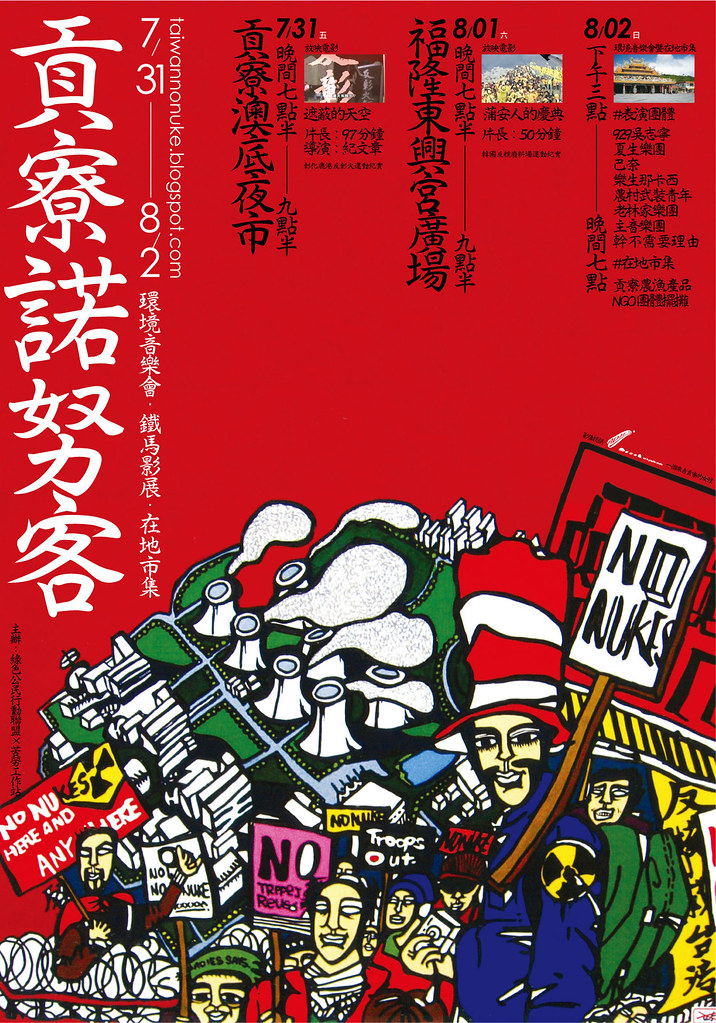
活動流程
7/31(五)
諾努客之鐵馬影展Part 1
時間 19:30~21:30
地點 貢寮澳底夜市
放映電影:遮蔽的天空
8/1 (六)
諾努客之鐵馬影展Part 2
時間 19:30~21:30
地點 福隆東興宮廣場
放映電影:韓國反核廢料紀錄片--蒲安人的慶典
8/2 (日)
諾努客之環境音樂會暨在地市集
時間 15:00~19:00
地點 福隆東興宮廣場
表演樂團:929吳志寧、夏生樂團、巴奈、樂生那卡西、農村武裝青年、老林家樂團、主音樂團
在地市集:貢寮農漁產品、反核運動資訊展售
[Voyage]樂活環保高雄之旅-玩樂住宿篇
 |
| From 20090704環保樂活高雄 |
由於我參加的環團營隊沒有提供住宿,所以我就上網找到了這家樂活玩藝,超值便宜又浪漫的雙人房.(平日600,假日700)
而且非常湊巧的,我到高雄是參加環保團體辦的營隊,而這個住宿空間也是標榜以環保概念而打造的.以下這段是他們網路上的介紹.
高雄便宜住宿~樂活玩藝~環保藝術創作住宿分享空間
非民宿~在吐瓦魯被海水滅國後決心對抗全球暖化.是第一個真正以環保概念打造的住宿空間(不同於環團般恐嚇方式,如吹冷氣會殺死北極熊.反而是以頂級變頻冷暖氣機應應,體驗環保快樂新生活,也許有人住過之後覺得沒啥差別,然而這就達到目的囉,表示您已經在不須作任何行為改變的情況下成功對抗暖化)可帶寵物入住喔
然而,我對於頂極變頻冷暖氣跟我們所睡的乳膠床到底是不是比其他種冷氣及床墊來的更環保,由於自己不是這塊領域出身的,實在不知到如何判斷起.不過,首先這個住宿空間的經營者想要在這裡實現一些環保的想法這一點,已經很值得拍拍手了.再者,樂活玩藝經營者廖小姐在跟我們說明如何使用房間的冷氣時,告訴我說設定整適當的濕度跟溫度,再配合風扇.房間就一整個呈現很涼爽舒適的狀態,不會像一些便宜的旅館冷氣一開就是讓人匹匹挫的冷,睡個覺起來冷到頭疼郁烈皮膚又乾到長紋.從這一點來看,至少可以發現這個住宿空間對於怎麼樣維持舒適但同時又不過度浪費地球資源是有一些很不錯的概念的.
不過我之後很有可能在類似環團的地方工作,樂活玩藝的網站介紹也是提醒我,在傳達重要議題的時,語言文字及表達方式的選用是這個議題是否能發揮影響力的重要因素之一.
躺在床上抬頭看到的美麗紫色薄紗
 |
| From 20090704環保樂活高雄 |
我跟瓦力7/3禮拜五從台中騎摩托車走台17線到高雄,從下午12點多出發,花8,9個小時騎過1/4個台灣.之所以花了那麼久是因為台17線風景太漂亮了.我們沿途一直就觀賞著台灣中部美麗的山景,經過純樸紅的西螺大橋,雲林台南鄉間葉影濃密蔓延數公里的綠色隧道,還有經營之神王友慶先生經營企業工廠大煙囪貢獻給台灣天空的工業污染雲朵,籠罩了台灣中部美麗的山頭.
原定計畫是要到台南的海邊停留一下再繼續前往高雄.但是到了台南時天色已經暗了下來,又碰上下大雨,不得不在路上的海邊小餐廳等待雨勢稍歇,順便吃點晚餐.此時晚間的海浪潮洶湧,夜色和著海浪衝擊著路上的大雨,漁船點點亮光搖晃著.因大雨溼透的衣服讓我們打著冷顫,吃完雨水海味夾雜的空氣跟熱呼呼的簡單飯菜後,繼續往高雄前進.
高雄17公里 高雄11公里 高雄9公里 高雄7公里 高雄5公里 高雄1公里
晚上9點多,我們終於抵達預定住宿的樂活玩藝,身上的溼衣服早已被公路急駛的空氣吃乾.經營者廖小姐跟她穿著蜜蜂條紋涼鞋的兒子小胖已經等候我們多時,這個地方在高雄市的大順橋下,藏身在灰灰舊舊的公寓當中.然而門一打開,馬上就是一番溫暖的新天地.
 |
| From 20090704環保樂活高雄 |
廖小姐跟她兒子可愛的小胖熱心的幫我們介紹住宿空間中的設備,包括電視,廚房,冰箱,洗衣機.進門的鞋櫃竟然是黏在大門後的,真是個省空間又有巧思的設計.不過小胖一直叫我阿姨,真是讓我太傷心了啦.......明明我那時還算是大學生阿><
--------------------------------------------------------------------------------------
雖然在高雄時大部份時候我們有機車代步,但是高雄的捷運也算是重要景點,一定要看一下的啦.
高雄捷運美麗島站的穹頂大廳
 |
| From 20090704環保樂活高雄 |
在捷運站內的地上我看到這個標誌,但不知道是什麼意思/東西.不知有無路過我部落格的好心人可以解答一下...
 |
| From 20090704環保樂活高雄 |
車廂內的吊環是弧型排列的,如此一來站著的人身體就不會那麼容易擠到坐著的人的臉上(瓦力說的)
 |
| From 20090704環保樂活高雄 |
滅火器也不是站在人會站立或活動的地方,而是有獨立的保護空間不用冒著被人踢倒的危險,但又容易取得.
 |
| From 20090704環保樂活高雄 |
-------------------------------------------------------------------------------------
在鼓山渡船頭的河邊,我們發現一家重型機車美式主題餐廳.除了店內放了好幾輛重型機車外,牆上還有好些類似荒野大鏢客的帥氣騎乘重機的海報,吧台掛滿機車車牌. 我們點了漢堡牛肉套餐,一整個大推薦.
 |
| From 20090704環保樂活高雄 |
 |
| From 20090704環保樂活高雄 |
--------------------------------------------------------------------------------------
在打狗領事館
 |
| From 20090704環保樂活高雄 |
瓦力說他一直覺得高雄是魔多,原來指的是高雄港這些大型的吊貨櫃機具,以及到處林立的大煙囪與工廠.
 |
| From 20090704環保樂活高雄 |
營隊結束後我獨自作客運回台北的路上,高速公路邊也是一堆建設堆砌在夜色裡.
 |
| From 20090704環保樂活高雄 |
2009-07-20
[voyage]樂活環保高雄之旅---環團營隊篇(下)
營隊第三天看紀錄片<企業人格診斷書>--如果企業是人,那他們具有什麼樣的人格?他們是如何對待社會上的其他人?
現在很當紅的"企業社會責任"到底是從企業本身的經營運作中就真正尊重關心到人、環境與生命,還是企業拿來掩飾生產本身對人與環境剝削的遮羞布,塑造好形象又可用以當逃稅的白手套?
---------------------------------------
下午時刻是實習報告時間,以下為您呈現我失敗的柴山探索之旅。。。

假日下午打狗英國領事館有相當多遊客,從口音判斷他們有很多是中國來的。不過那不是此篇文章的重點。
我在搜尋拍照對象時,發現了一個類似雕刻的東西。

仔細看上面的說明

非常剛好的,前一天半的課程中也有提到,台灣的原生檜木在日本時期開始被大量採伐。到了國民黨來台以後,甚至有官方資料顯示政府有計畫的要把所有的原生檜木砍光。
再看到英國領事館內的展覽的立牌,頓時感到有些矛盾...

把英國領事館逛過一圈後,該開始去找柴山,看猴子了。。
很不幸的是,聽說中山大學後的柴山入口被軍事管制進不去。所以只好隨便在中山大學那山頭找個看起來可以走走爬山的地方。
中山大學的校舍被濃密的樹包圍著,面向美麗的海景,好一幅人類開發與自然共存的和諧景象。(在我學會把照片轉正前,請把脖子左彎90度觀看)

然而,就在路邊,這棵大樹因為馬路開到她的生長空間而被斷手斷腳,車輛在順遂的馬路上徜徉而過。

以上就是我失敗的柴山之旅,但是很榮幸這個貧脊的報告還是得到一點點同情票。

現在很當紅的"企業社會責任"到底是從企業本身的經營運作中就真正尊重關心到人、環境與生命,還是企業拿來掩飾生產本身對人與環境剝削的遮羞布,塑造好形象又可用以當逃稅的白手套?
---------------------------------------
下午時刻是實習報告時間,以下為您呈現我失敗的柴山探索之旅。。。

假日下午打狗英國領事館有相當多遊客,從口音判斷他們有很多是中國來的。不過那不是此篇文章的重點。
我在搜尋拍照對象時,發現了一個類似雕刻的東西。

仔細看上面的說明

非常剛好的,前一天半的課程中也有提到,台灣的原生檜木在日本時期開始被大量採伐。到了國民黨來台以後,甚至有官方資料顯示政府有計畫的要把所有的原生檜木砍光。
再看到英國領事館內的展覽的立牌,頓時感到有些矛盾...

把英國領事館逛過一圈後,該開始去找柴山,看猴子了。。
很不幸的是,聽說中山大學後的柴山入口被軍事管制進不去。所以只好隨便在中山大學那山頭找個看起來可以走走爬山的地方。
中山大學的校舍被濃密的樹包圍著,面向美麗的海景,好一幅人類開發與自然共存的和諧景象。(在我學會把照片轉正前,請把脖子左彎90度觀看)

然而,就在路邊,這棵大樹因為馬路開到她的生長空間而被斷手斷腳,車輛在順遂的馬路上徜徉而過。

以上就是我失敗的柴山之旅,但是很榮幸這個貧脊的報告還是得到一點點同情票。

2009-07-13
[voyage]樂活環保高雄之旅---環團營隊篇(上)

7/4-6我到高雄去參加地球公民協會所辦的2009環保小尖兵活動.為了參加這個營隊,我特地買了環保筷跟環保杯,並在杯子上貼上VIVA DALAILAMA的貼紙,這是我前一周去參加西藏自由青年營時,逆轉的Freddie為了要宣傳7/11的西藏自由音樂會
回到正題,DAY1
7/4(六)第一天的開幕式,致辭者是該協會的副理事長。他所說的第一句話是小小的埋怨了一下遲到的人(看來我是其中之ㄧ),覺得遲到是一種不體貼他人的行為。然後開始用日本人守時來說明日本人做事成功是基於精確等等等。最後說到人若是懂得體貼就會對環境有關懷。
os..我遲到了一點的確我得認錯..不過我得說他致詞內容中除了體貼會導致對環境的關懷的一點外,其他部分的論述因果關係都很莫名奇妙,只是為了抱怨不守時的人而拿一些不知所云的例子出來支持。
Anyway,後面的自我介紹時間是透過抽出不同學員的名字,學員間透過簡單的訪問最後以介紹被訪問者的方式互相認識。這是一個相當有趣新穎的自我介紹模式,訪問我的人跟我的受訪者在此次營隊中都是跟我比較熟悉的。

之後當天的課程都相當有趣。第一個部分是介紹台灣的環境跟動植物生態,講者真的很熱愛大自然而且也有很多豐富的戶外活動與自然觀察的經驗。許多美麗的生態圖片讓人看了非常驚艷,這些美妙的經驗真的會讓人愛上台灣這個美麗的寶島。很可惜的是我本身這樣的經驗不多,但是這個場次的呈現讓我很想沒事多去探索台灣的自然。
第二個部份是執行長李根政說明台灣自然與開發之間的關係。從他身上可以感覺到,從事環境議題的工作者所懷抱的理想性跟使命,非常動人。我自己開始對環境議題有些感覺應該是參加台權會辦過的原住民法律實務研討會,那個場合中我聽到很多有關原住民對於環境的智慧,但是在以漢人文化為主的法律制度與經濟利益優先的思考之下,原本與人共生的自然遭到破壞,保護者還受到法律的懲罰。
下午的時候,兩位環境新聞工作者來說明媒體報導在環境保護上發揮的作用。我非常喜歡立報的胡慕情,在一開頭的時候,就問"喜歡政治的人舉手"。
舉手!我不禁想要大笑,身為政治系的學生又沒事喜歡在抗議或遊行場合參一腳的我,早就不知道被多少人問過為什麼要念政治。全場只有兩個人舉手,其他多數人對於政治要不就是參與無用或是骯髒邪惡的想像,也是我預料之中的事。
胡慕情闡述的方式是將政治解為公共事務,雖然她並沒有明白地使用"政治=公共事務"的語言。她用樂生療養院的例子來說明公民記者(不同於有廣告商/政府立場等等主流媒體)在現代社會發揮的作用--把訊息正確的傳達出去。她的講綱中有一個問題我也很喜歡-"如果一棵樹倒了,但是新聞沒有報,那這棵樹倒了沒有?"獨立記者朱淑娟曾在某大報工作非常長的一段時間,大報對於環境事件的報導對於政府官員曾經也相當的有影響力。但現今媒體林立,媒體做為第四權監督政府的威力似乎也被各式各樣的因素給稀釋掉了。
胡慕晴用部落格廢業青年日記的圖說樂生院:90%,懶的面對的真相引起的網路迴響,說明新聞事件資訊被正確的揭露與傳遞之後產生的影響力。


我從高中開始比較常看新聞/談話節目/報紙以來,直到自己從去年起開始參與了一些新聞事件後,才真正覺得自己知道要怎麼看新聞或報紙。B立場的議題在A報紙永遠不會出現,所以如果只看一份報紙,這社會中有一大堆事情對閱聽者來說根本沒發生過,尤其是該份報紙不喜歡讓讀者知道的事情。網路有時反而是比較充實的資訊媒介,一則新聞的關鍵字下去,除了可以看到不同媒體對該新聞關注的重點外,還可以立刻看到關心相關議題者(ex.部落客)對這則資訊的評論與分析。
其實我一直以來參與較多的活動跟環保沒什麼太大關係.最開始有一點關係的大概是在台權會辦的原住民法律實務研討會上,聽到原住民的文化中人與環境共生的智慧,在以漢文化與財產私有的法律體制下,政府財團的破壞開發有理,原民反變成了山老鼠.
最後一場是公視<我們的島>系列節目的影像工作者柯金源,分享他透過製作節目追蹤台灣各地環境的狀況。這樣影像紀錄跟報導比起來,使得一般人能夠透過影片更深刻的去感受我們環境面臨的處境,相當程度上可以發揮教育的效果。
這裏附上一小段公視<我們的島>報導高雄柴山的節目
之所以要放柴山的影片,主要是為了彌補我第二天探訪柴山計畫的失敗。。。。
第二天下午的實習課程,大部分學員選擇了以訪問或問卷的方式來了解民眾對特定議題的看法。其他學員分組所做的主題是飲料店對選用環保材質飲料杯的看法、高雄人對高雄水質的看法、民眾對於台電大林廠資訊的認知與意見。
而我在前一天半的課程中,得知高雄的柴山作為這個高度工業化都市中難得的山林綠地。曾經(或正在)面臨被開發的問題。這讓我想到台北的松山菸廠事件,同樣的也是在討論都市綠地。
再加上我實在不想一直呆在會議室裡上課或是去做訪談(以前的工作經驗讓我知道自己真不是個訪談者的料...)。不過很不幸的沒有其他人想加入我爬山踏青的行列,跟協會的工作人員討論過後,我就自己一組去做柴山了。
我從協會借來一本介紹柴山的書,裡面出現了打狗英國領事館的照片。(所以英國領事館那兒也可以進到柴山吧,我想...)
接續....
2009-06-11
[Ecrire]台灣的TONE調?
上音樂與政治時,音樂系的彭老師第一堂課就問:台灣的tone調是什麼?
他之所以會如此的問,是因為他發現俄國德國等國家的音樂很能反映他們的民族性格與文化,而他覺得台灣/中華民國到目前還沒有產生那樣子的音樂.但是他又認為台灣是華人世界裡面傳承中華文化最完整的地方.
其實我有些迷惑:彭老師想尋找的到底是可以代表中華文化的音樂的呢?還是可以代表台灣的音樂?還是是可以反映出台灣的中華文化樣貌的音樂?台灣一直都是個移民社會,有不同國度地域的人來來去去,跟德國俄國有一支確定長治久居的民族情況看來並不相同.即便是所謂的"中華文化",滿漢苗疆回這麼多族,如何決定誰才是"中華民族"?要用誰的文化來說是"中華文化"?要比統治勢力大小/統治時間長短/還是比人頭?為什麼一定要有"一個"TONE調?
雖然我偏見認為彭老師念茲在茲的,始終跳脫不出所謂的台灣在這個輪廓模糊不清的"中華文化"上的傳承與表現,但是到底什麼是"台灣的TONE調"的確是一個很值得去思索的問題.
不過,音樂本身真的有這麼大的野心,要"代表"一整個民族一整個社會一整個世代嗎?
即使是"國"歌,這歌真的呈現了我心目中自己國家的樣貌嗎?
阿里山的姑娘美如水-可是我不住阿里山阿...........
威士比是我的兄弟-不過我不是喝威士比+沙士,灑著熱汗的基層藍領阿...
梁祝--我一點都不想為了男人自殺然後再變成蝴蝶的說...
望春風/雨夜花--我很喜歡,但是思春悲慘的少女不是我的夢想
.........
到底什麼音樂才讓我覺得"是我!"?
XXXXXXXXXXXXXXXXXXXXXXXXXXXXXXXXXXXXXXXXXXXXXXXXXXXXXXXXXXXXXXXXXXXXXXXXXXXXXXXXXXXXXX
我們搖籃的美麗島 是母親溫暖的懷抱
驕傲的祖先正視著 正視著我們的腳步
他們一再重覆地叮嚀 不要忘記 不要忘記
他們一再重覆地叮嚀 蓽路藍縷以啟山林
婆娑無邊的太平洋 懷報著自由的土地
溫暖的陽光照耀著 照耀著高山和田園
我們這裡有勇敢的人民 蓽路藍縷以啟山林
我們這裡有無窮的生命 水牛 稻米 香蕉 玉蘭花
我不想為了什麼祖先的期待而活著
但是這首歌讓我想起
看著閃耀在陽光下翠綠山谷時的屏息,
在花蓮在屏東在坪林在宜蘭
海風吹來雙腳踩著濕潤沙子的清涼,
冬夜自由廣場上悠悠的溫暖
晚風颼颼讓我頭疼可是我感覺很堅定
2009-05-27
[轉錄]關注六四,是對我們民主與人權信念的試驗

台灣公民社會支持紀念「六四」二十週年聲明
我們都還記得,整整二十年前,許許多多台灣人民在電視前看著坦克車開進北京城,看著學生與市民身上滿溢的鮮血,我們流下了眼淚。我們也都記得,當時朝野政治人物如何批評中國共產黨,演藝界群星攜手激動地吟唱「蒙上眼睛,就以為看不見」。我們記得,那是「歷史的傷口」。
二十年後的今天,以及過去許多年,台灣人民彷彿患了集體失憶症。如今,台灣的媒體及執政黨齊聲歌頌的主旋律是「發展才是硬道理」,是中國美麗風光的旅遊,是上海北京的雄偉建築。我們忘記了這個國家二十年來,依然被一個不折不扣的專制政權所統治。八九民運人士仍然身陷獄中或在海外流亡,天安門母親依然被圈禁在家中暗自飲泣,甚至在中國各角落不斷有人為著爭取人權、保護弱勢竟被逮捕關進黑牢。我們還能視若無睹嗎?
台灣人為何要關注六四?因為這是對我們自身民主信念的重要試煉。
首先,做為一個走過民主化荊棘路的民主國家公民,我們深信民主與人權乃是普世價值。我們固然要關心台灣本身民主的缺失,同時我們也應該關注鄰近國家的民主與人權,和那些爭取民主的鬥士站在一起。
其二,在目前的兩岸局勢中,對經濟利益的關注成為海峽兩岸最大的共識。八九之後,中國一切向錢看,市場支配一切,六四以及其他政治改革的呼聲全被消音。而當台灣和中國互動愈加密切,我們似乎也感染了歷史失憶症與民主冷漠症。在這個兩岸大和解的氣氛下,人權似乎成為最不合時宜的話題。但如果我們附庸於中國的主流論述,眼中只看經濟利益,深怕得罪中共當局而不顧人權與民主,這豈不是對我們自己辛苦紮根的民主信念最大的嘲諷嗎?
我們不能再冷漠。在「六四」二十週年的今天,我們呼籲台灣各界應該和全世界有良知的人們站在一起,展現我們追求民主與人權的決心,支持追究「六四」責任、推進中國民主的一切努力!
連署人簽名:黃默、黃文雄、林世煜、王興中、蔡季勳、李仰桓、林欣怡、李介楣、楊長鎮、張鐵志、阿潑…
關注六四,參加連署
2009-05-22
[聽演講]全世界最不關心六四的兩個地方: 中國跟台灣
中國在鄧小平主張改革開放之後,經濟逐步發展.但1989年這個主張改革開放的政府對走上街頭的學生及一般市民,仍然派出坦克進行血腥鎮壓.六四天安門事件即將屆滿20周年,中國的經濟更加蓬勃發展,現今中國人民的處境又是如何??
<六四20周年 校園巡迴影展><中國當代社會觀察 校園巡迴影展>
-----------------------------------------------------------------------------------
上週末我跟一群朋友去信義誠品聽王丹跟張鐵志談六四天安門學運. 今年是六四滿20周年,各國媒體都在回顧跟檢討這20年來天安門事件對於世界及中國的影響是什麼.但至目前為止,台灣沒有任何媒體要求採訪他.
王丹: 全世界最不關心六四的兩個地方,就是中國跟台灣.不知道以後會不會變成一個地方.(全場笑)
聽著王丹說著他人故事般的講著,當時市民幾乎都住在街上不讓坦克車開進北京的景象.長安街上的人們不知多少葬身在政府的子彈下.就因為一群學生要求政府為一篇偏激的社論道歉,且誠意跟學生展開對話.
去年野草莓在自由廣場的時候,有位自稱在外交部工作的先生,中午休息時間時,散步來廣場,客氣地說想跟我聊聊我們這些學生在做的事.他說:"你知道天安門事件吧"
"要是我是政府,明天我就叫坦克車開進來了"他很認真的,以討論問題的姿態說著.
"我想...我們政府應該比中國政府聰明一些."我也客氣的答覆他(OS:還好你並不是政府)
政府對待討厭的反對聲音,來個相應不理的確是比亮出子彈坦克的聰明的多,反正人民總是健忘.只要撐到別的新聞點(ex.扁案)出現,媒體自動會讓事件消失在大眾的生活中.等到下一次選舉時,這些事情大部分人早就忘的一乾二淨.政治對手的攻擊看起來就會變成無聊的翻舊帳.
對於許多中國人來說,20年前的天安門事件,可能根本沒出現在這世界上過,長安街上的遍地橫屍也是.又或者,抗議的人反正只是暴民,他們拿著石頭棍子砸荷槍實彈的解放軍跟鋼鐵包的坦克車.
王丹跟張鐵志在誠品的演講,影音全記錄
http://anchor1106.blogspot.com/2009/05/x-back-to-1989.html
<六四20周年 校園巡迴影展><中國當代社會觀察 校園巡迴影展>
-----------------------------------------------------------------------------------
上週末我跟一群朋友去信義誠品聽王丹跟張鐵志談六四天安門學運. 今年是六四滿20周年,各國媒體都在回顧跟檢討這20年來天安門事件對於世界及中國的影響是什麼.但至目前為止,台灣沒有任何媒體要求採訪他.
王丹: 全世界最不關心六四的兩個地方,就是中國跟台灣.不知道以後會不會變成一個地方.(全場笑)
聽著王丹說著他人故事般的講著,當時市民幾乎都住在街上不讓坦克車開進北京的景象.長安街上的人們不知多少葬身在政府的子彈下.就因為一群學生要求政府為一篇偏激的社論道歉,且誠意跟學生展開對話.
去年野草莓在自由廣場的時候,有位自稱在外交部工作的先生,中午休息時間時,散步來廣場,客氣地說想跟我聊聊我們這些學生在做的事.他說:"你知道天安門事件吧"
"要是我是政府,明天我就叫坦克車開進來了"他很認真的,以討論問題的姿態說著.
"我想...我們政府應該比中國政府聰明一些."我也客氣的答覆他(OS:還好你並不是政府)
政府對待討厭的反對聲音,來個相應不理的確是比亮出子彈坦克的聰明的多,反正人民總是健忘.只要撐到別的新聞點(ex.扁案)出現,媒體自動會讓事件消失在大眾的生活中.等到下一次選舉時,這些事情大部分人早就忘的一乾二淨.政治對手的攻擊看起來就會變成無聊的翻舊帳.
對於許多中國人來說,20年前的天安門事件,可能根本沒出現在這世界上過,長安街上的遍地橫屍也是.又或者,抗議的人反正只是暴民,他們拿著石頭棍子砸荷槍實彈的解放軍跟鋼鐵包的坦克車.
王丹跟張鐵志在誠品的演講,影音全記錄
http://anchor1106.blogspot.com/2009/05/x-back-to-1989.html
2009-04-30
[Ecrire]浪漫的家父長主義 又何止存於優生保健法

<圖片>2008年東吳法律系系服
來源:東吳大學法律系一般公告http://law.begonia.tw/php/chi/newsdetail.php?id=198
東吳大學法律學院的2009英美法教學研討會上,官曉薇老師介紹了美國法上對於中止妊娠之法律判決中,經常地以"保護婦女健康"為由. 而在美國歷史上經常以"浪漫的家父長主義"思維來限制婦女的權利與自由的判決,比如說禁止女性從事律師(因為當時已婚女性要簽契約必須得到丈夫同意,因此已婚女律師在與客戶簽約時會有困難),調酒師,或礦工,長時間工時的工作(危險,對女性的身體有傷害,妨害下一代的孕育)等等. 判例Roe v. Wade確認了女性的中止妊娠權(粗俗一點叫墮胎權)有時期上的差異,直到2000年之後許多反墮胎團體提出"墮胎危害婦女健康"的論述,並成功說服一定數目的州去制訂限制墮胎的法律. 但這些法律的生效都必須以Roe v. Wade被最高法院推翻為前提.
浪漫的家父長主義(Romantic Parentalism),據官老師簡要的說明,是基於女性較脆弱,無法自主決定或處理危險情境的假設,而透過各項政策或是法律制度來限制女性從事所謂危險的行為.
其實我沒有想做甚麼摘要,因為這些我之前就已經知道.不過當研討會結束我經過法律系系辦公布欄時.我看到這樣的一個公告:"沒有參加系會的XXX,XXX,XXX同學,請於X時X地參加導正教育" 很慶幸的,東吳法律系並不把我這種非科班出身的人當自己系上學生,所以我的名字也不可能出現在這種公告上.不過不才我能夠想像到之所以不參加系會竟需要被導正的理由,也只有"小朋友不乖呦,竟敢不來表示你的責任感跟愛系心是需要培養的.讓學富五車,修養過人的系辦來教教你"
我真的不知道這些大人的強大控制欲是從哪兒來的.保障權利跟自由是法律的原則, 不過永遠都有人只想先設例外,然後將例外無限擴張到讓原則只是粉飾門面的藉口.
2009-01-16
Taipei Times專訪:自由之家強調捍衛民主

Members of the audience examine a “Map of Freedom” and other documents published by the US nonprofit organization Freedom House at the global release of the group’s report at Far Eastern Plaza Hotel in Taipei yesterday. The event was hosted by the Taiwan Foundation for Democracy.
PHOTO: WANG MIN-WEI, TAIPEI TIMES
Published on Taipei Times
http://www.taipeitimes.com/News/taiwan/archives/2009/01/14/2003433733
INTERVIEW: Freedom House stresses safeguarding of democracy
Freedom House released its annual ‘Freedom in the World’ report in Asia for the first time yesterday. The Freedom House delegation — Christopher Walker, director of studies; Bridget Welsh, academic adviser and a professor at Johns Hopkins University ; and Sarah Cook, Asia researcher — talked to ‘Taipei Times’ staff reporter Huang Tai-lin on Monday, sharing their thoughts on Taiwan’s democracy and how they are looking closely at the ‘bumps in the road’ it has encountered late last year to see whether they would have any larger implications this year
Wednesday, Jan 14, 2009, Page 4
Taipei Times: On Nov. 20 last year, Freedom House issued a statement calling on the Taiwanese government to set up an independent commission to investigate the clashes between demonstrators and police during Chinese envoy Chen Yunlin’s (陳雲林) visit. Have you seen anything that has either eased or aggravated such concerns?
Christopher Walker: There have been some developments in Taiwan in recent period that’s been a cause of particular concern, and that was one of the driving reasons for the issuance of the statement we released late last year, and something we are monitoring very closely now. So 2009 is really a critical year for Taiwan in our evaluation, because many of the proceedings, measures and events that we started to track last year will be moving forward and perhaps moving toward completion, so this would be a critical year for seeing how Taiwan institutions respond, and to see whether they self-correct that suggest the democratic system is working effectively.
Bridget Welsh: A lot of things involving trials, for example, we wait to see the overall process. When a trial begins, you don’t want to judge too quickly, you want to wait and see how the process evolves. Before we make an assessment, we try to look for more effectively how things have changed, as opposed to event-driven.
Sarah Cook: We understand several channels have been found. I think there was a police investigation started internally; there had been a request for an investigation by the Control Yuan, and we are following that to see how those have been investigated. There have also been some cases that have been submitted directly to the courts by people individually who think their rights have been violated by the police, or by some other restrictions. All these are all in a very kind of early stage now. Nonetheless, it is an encouraging sign to see at least steps are being taken. But we will be following to see how fair and how in-depth and how impartial this judiciary goes.
TT: Taiwan qualifies as an electoral democracy. However, some have expressed concern that with the Chinese Nationalist Party’s (KMT) controling both the executive and legislative branches, there maybe a democratic tyranny in the making, or an authoritarian regime that exploits democracy. Have you come across such concerns in your analysis?
Walker: I think there’s always the concern that if you have a dominant political force, this may somehow diminish the checks and balances. But I don’t think it is necessarily the case. I think you have to keep a close eye on whether the institutions of democracy are doing their job in preserving the independence of judiciary.
For example, in a democratic context — ensuring that prosecutions are not done selectively, that they are being done according to the rule of law, being done on the basis of facts, and not on basis of some sort of political direction. In any sorts of setting where you have a single party dominate democratic institutions, you have to be mindful and careful about [these things]. The priority is not to say that it will be the case, there’s more of a question of keeping a close eye on the institutions that retain their integrity, whether or not there’s one party in control.
TT: So, so far there has not been any flag that has prompted concern about Taiwan in that regard?
Welsh: Next year’s [this year’s] local elections will be really important. The process of electoral campaign, the issues of free demonstration and protests, these things are really important and we look at every country when we are making an assessment. The rights of assembly and the rights of people [from all sides] to express themselves — all these things are what we look at consistently, and not just in Taiwan, but across the board. I’d say these things are very much on our agenda and we’ll look at Taiwan and see how Taiwan evolves this year.
Cook: The KMT has a very specific history, and there are other concerns in Taiwan. That’s one of the reasons why we are watching it closely, but I think it does not necessarily need to be an assumption that there would be an erosion of democracy because a particular party holds both the Executive Yuan and the Legislative Yuan.
TT: On the Assembly and Parade Act (集會遊行法), the ruling and the opposition parties have reached a consensus on amending the law, requiring protesters to notify the authorities ahead in lieu of the practice of seeking permission from the authorities. There has been debate on whether notifying the authorities should be voluntary or mandatory. What are your thoughts on it?
Walker: The first thing I would say is democratic societies tend to have a variety of different ways in treating this issue within the democratic [framework], so there are instances where some sort of notice is required. I think the key is that the notices and the requirements are not applied in a selective way, or that diminishes opportunity for a meaningful assembly, association and vocalization on these issues. And we have heard a lot on this issue because of events [that happened] last year. Because of the issues we just discussed, it is important that steps are taken to ensure that freedom of assembly is fulfilled.
Welsh: We look at things very comparatively. I just came from Burma, and Burma is not Taiwan in terms of what the conditions are on the ground, what the circumstances are, same thing for what’s going on in Thailand, what’s going on in Malaysia, in Korea, there are different circumstances. For Taiwanese, they are thinking in chronological process, they are thinking from a historical framework, which we appreciate and we understand. But at the same time, what we do is we look at how Taiwan compares to other countries.
TT: We understand that the Freedom of the World report compares the practice of democracy in different countries. Since Freedom House conducts an annual survey, we can compare how a country, in this case, Taiwan, is doing this year compared with last year or two years ago. There’s concern that might have been some democratic regression in Taiwan based on what happened in the past couple of months. What are your thoughts on that?
Walker: I think the point to keep in mind in the Taiwan case is that when we evaluate a democratic system — and Taiwan is clearly in a democratic group of countries — there is the assumption that the democratic institutions should respond.
It is not to say that they do in every instance, but for our purposes, given the chronology of events in 2008, when the elections occurred, when the rotation of power occurred, some of the events of concern that emerged near the last quarter of the year, the question now is, these are events that are in process, how they are fulfilled and completed, so our expectation is that these will move along over the course of this year in a way that will allow a meaningful evaluation of the way they have been fulfilled or not. 2009 is a pivotal year on many of these important questions that are now moving to the top of agenda in Taiwan.
When [you] talk about a country like Taiwan, you really are talking about the challenge of how you can improve a democratic process that is strong, but not perfect. It is a very different sort of conversation when we are talking about countries in the middle of category [for our report], very different sort of conversation once you talk about Burma, North Korea, and the rest of the world.
The media, of course is critical. When you look at countries that are successful in tackling corruption, invariably they have open, independent, and vibrant media, in addition to an independent, capable judiciary and a compatible political environment. You can have countries that are horribly corrupted, where not only don’t you have discussion of corruption but you don’t have meaningful means to tackle it in a tyrannical setting.
So conversely when we look at country like Taiwan, we say what is it that worked to ensure that the institutions are doing what they are meant to do, that they are being safeguarded, that the debate is constructive, not polemical, and the judiciary is working according to rule of law, not according to select application of it, towards one political party, or another, certain people. It is important to emphasize that we are looking at institutions’ performance, we are looking at how these institutions fulfill their responsibilities.
By way of comparison, China will have an enormous problem tackling corruption over time, in our view, precisely because the media has so many obstacles to operate in an open and independent way. Likewise, while there have been efforts to modernize the judiciary in China and to add to its capacity, there is really a significant question mark as to whether that will be successful over time.
In the Taiwanese context, we are really looking to make sure that these institutions are safeguarded and that they are fulfilling the roles that they achieved with work and success over these last 20 years.
TT: Freedom House has ranked China in the past as “Not Free,” whereas Taiwan has often been praised for it democratic achievements and dubbed a beacon of democracy for China. In light of recent events, however, some fear that in the tug of war between Taiwan and China, rather than Taiwan pushing China gradually toward democracy, it is China that is influencing Taiwan. The KMT government is known for its pro-China policy. Some fear that Taiwan’s closer alignment with China may be made at the expense of Taiwan’s democracy.
Walker: Last year was the year of the Olympics, and there was hope that this would inspire more progress on human rights and democratic reforms. We didn’t see it and that was really disappointment, and also, a missed opportunity in many ways.
Cook: We have to keep thing in perspective in terms of whether it is one incident that is a violation of civil liberty versus the full grown regression of democratic, and I think that’s the problem that’s trying us now — are these just bumps in the road ... or is there something bigger happening here now that’s more institutional level.
In terms of what you are talking about, we are very much paying attention, particularly when there’s any kind of links between complaints about rights violation in Taiwan. It maybe a little too early to judge right now, but it will be one of the things we will be looking at in 2009.
TT: You mentioned bumps in the road. In your assessment, how many bumps, or incidents billed as isolated cases, will there be before you start thinking something might not be right?
Walker: I’d think of how much these cases have actually worked through the process. If the judgment is that the process hasn’t been responsive and, for example, the trials for former president Chen [Shui-bian (陳水扁)] are decided a week from now, I suspect over the course of this year, that case or other important cases, will [give us] sufficient information to make assessment. Again, not to repeat, but in 2009, given things that started after last year’s elections, after the rotation of power, after some of these events again in the last part of the year, all of these things suggested that this year, depending on how they are administered, or dispensed with, will determine our evaluation on these issues.
Welsh: One thing I’ll say is although there’s the polarization, blue and green and so forth, there’s a healthy debate. There’s a healthy discussion here on some of the key issues, and even the most recent negotiation on the assembly provision, I think about how to a certain degree, the system is working. Not to say that it is perfect, nowhere is it perfect, but you have the dialogue and discussion, and some compromise is being reached. That made some changes already in the way the law is being amended. Process is very important. Democracy is not just about elections, but is also about process.
TT: There is concern that the with new US administration under president-elect Barack Obama, Washington may be anxious to promote good relations with China and overlook human rights violations in Taiwan. What approach would you suggest to show the new administration’s support for Taiwan’s democracy?
Walker: I think it is pretty fundamental. I think you’d hope any administration would keep a close eye on developments here and do anything in its power to enhance, and safeguard the country’s democratic development.
The Freedom House’s position is that, there are a range of interests and concerns that the United States would have with many countries, but in no case, should issues of human rights, transparency, democratic accountability be set aside, it should be part of that larger discussion.
Copyright © 1999-2009 The Taipei Times. All rights reserved.
2008-12-14
[人權]世界人權日天亮之後 圖博,自由,與台灣警察
2008.12.11凌晨3點多,強勢警力摸黑進入自由廣場,驅離睡夢中的圖博人和野草苺學生。
10點多圖博人到蒙藏委員會陳情儘快找回被送走的同胞,並要求負起照顧「藏胞」的責任。
11點後至下午,被驅離的圖博人陸續尋獲並送回自由廣場...
文字與影片引用自PeoPo公民新聞平台
10點多圖博人到蒙藏委員會陳情儘快找回被送走的同胞,並要求負起照顧「藏胞」的責任。
11點後至下午,被驅離的圖博人陸續尋獲並送回自由廣場...
文字與影片引用自PeoPo公民新聞平台
2008-12-11
[轉載]世界人權日剛過的凌晨 自由廣場和平抗議之學生與圖博人被強制驅離
作者 hialan ( ) 看板 action1106
標題 [記實] 野草苺驅離懶人包
時間 Thu Dec 11 07:14:52 2008
───────────────────────────────────────
這是事件發生時,網路上同步的轉播訊息。
為維護同學帳號的隱私,因此將發表文章的 ID 刪去,僅留下訊息時間。
推文者的 ID 僅留下開頭第一個字母以供分辨。
12/11 03:35:45 2008
【緊急通知】警方來抄場子!!
廣場上傳來的訊息,
警方目前來現場抄場子,
已經啟動大型拖吊車,預計凌晨四點會進行抄場。
主播組的主播已經準備live轉播,
負責拍攝DV的同學也趕往現場側錄。
http://zh-tw.justin.tv/action1106
連結為野草莓網路轉播平台,
希望有同學在網路上也可以幫忙側錄。
04:04
網路不穩,現場沒辦法好好轉播,以文字轉播:
目前警方已經舉了第四次牌,十分鐘前才舉第三次,
主播們被圍在外圈,而警方圍住了裡面的同學,
現場有警備車在,也有大型吊車要吊小屋。
→ F:在左邊牆前靜坐的圖博人被趕走了? 推 12/11 04:05
→ t:是的!!! 圖博人也被包圍 推12/11 04:06
→ F:國際大笑話,可恥的河蟹社會 推12/11 04:11
04:11
現在現場又來了四輛警備車,主播看不見的範圍似乎還有,
包圍範圍越來越大、警察越來越多,
目前圖博人有在喊自己的口號,
警察不讓主播群靠近,網路上也斷斷續續的,
因此teiko在家和現場主播連線,以文字轉述。
→ w:是有需要動用六台警備車嗎... 推 12/11 04:13
→ f:快打蘋果24小時爆料專線!!!!! 推 12/11 04:13
→ t:麻煩幫忙打!!!很緊急!!! 推 12/11 04:14
04:14
目前圖博人已經被警方趕離小屋,就是我們野草莓借給他們的小屋。
據亞當主播轉述,現場目前警察非常多,
所以學生們完全看不到圖博人,完全被警方包圍。
04:16
現場來電
因為現在大部分記者都在睡覺或剛起床
有資源或管道聯絡到記者的
請幫忙聯絡記者
謝謝
→ f:我打去蘋果爆料專線 是答錄機 推 12/11 04:17
→ f:已經留言.. 推 12/11 04:18
04:19
目前兩台警備車將圖博人帶走,
學生們也一邊開始撤離物資,
現場有些同學、民眾前來聲援,
也呼籲方便的同學趕快集結到自由廣場。
→ t:我通知亞當了,他會通知同學!! 推 12/11 04:22
→ w:我在淡水,無法過去 推 12/11 04:22
→ w:請照顧好自己 by醫療組 Q_Q 推 12/11 04:22
04:23
目前第三台車帶走了所有的圖博人,
警察以非常快的速度在清圖博人物資,
據亞當、神行主播粗估,警方至少來了250人!!!
04:26
目前警方照明燈已經打過來照到學生這一邊了,
神行主播說,警方人數太多了,學生完全無法抵抗,
目前學生的物資能撤的已經盡力在撤了,
主播組這邊也是,電腦已經背在身上了。
04:29
重機現在已經駛入廣場,楊子頡同學爬上了草莓塔,
預計警方下一波的對象就是學生了!!!
04:29
剛剛打到民視,跟總機有接通,也有告知他自由廣場上,警察約來了 250 人
他說,我幫你找找看有沒有人,然後我就被轉接了。
轉接以後沒有人接,就被語音掛斷。
再播過去,就是「現在是下班時間」。
04:32
請大家趕快在起重機前坐下,
或盡可能爬上塔!
我等著看這個政府敢不敢從學生身上壓過,
或者連人帶塔一起弄倒!
→ f:人購的話也可以躺在屋子裡 推 12/11 04:33
→ m:這樣會被抬走 推 12/11 04:33
→ f:S那就爬到塔上吧 推 12/11 04:34
04:35
現在警方已經包圍了部分學生,
警方全集結在圖博那一區,
主播小屋已經被包圍,
目前人力捍衛草莓塔,子詰在草莓塔前不下來。
幾乎所有學生都坐在廣場布條前,
目前還有部分人力盡力把設備撤走,
我們不確定目前設備還有多少沒撤,
因此目前只能撤走重要物資。
目前警方人力大約有三百人。
警方在放話威脅我們,不要逼他們舉牌,持續放話中。
所有的焦點在草莓塔上,因為強用會出人命,
揮舞旗幟的人被警方以蠻橫的方式搶走旗幟,
目前爆發第一波衝突,目前警方與昇佑起口角。
警方又開始圍人,他們將木屋區圍起來,
將有的東西都圍起來。
→ f:學生有多少人? 推 12/11 04:36
→ w:醫療組有人出發了,緊急徵求人力幫忙 推 12/11 04:37
04:39
請務必注意安全
我的看法是不必死守場子
反正新的基地已經差不多找好了
靜坐 被抬走 這樣就夠了
務必小心不要讓自己受傷
04:40
所有的學生坐下來。
李明璁老師來了,要勸子詰下來!
警方開始舉牌,拒絕我們提出異議書。
警方這裡超過我們十倍以上的人力,
警方舉牌了!!!他們舉牌的對象為李明璁老師和聲佑,
並用集遊法威脅我們。
之豪也趕到了!!
現在全場大喊異議書,這是我們唯一合法的手段。
重機開進來了,警方多到不像話,
主播台和草莓塔這塊區域整個都是警察,
整個將學生包圍。
04:41
我想現在的情況,很需要懂醫療的同學幫忙協助萬一有人受傷的處理,
目前醫療組有一位EMT-2在前往現場的路上,
想多徵求一些人力幫忙,以免有狀況發生。
如果在板上有看到的朋友,可以過去幫忙嗎?謝謝
我人遠在淡水,只能多打電話叫人起來了 (U)
醫療組同學
04:43
警備車現在開進來了,用輕浮的口吻說:火力全開!
完全就是濫權的一種方式。
後面一直有警察跟著神行主播!
→ F:快叫計程車,把警備車堵死! 推 12/11 04:44
→ c:DV錄起來! 推 12/11 04:45
04:47
現場決議,無論被警方丟在哪裡,
還會持續回來。
警力持續回來圍住草莓塔,子詰依然沒下來,
學生依然坐在草莓塔前。
警力又將草莓塔圍了一圈。
主播群目前是神行在外圈,主播群除了神行在外圈以外,
其餘人都在內圈。包括負責DV的同學。
他們再進行包圍。
04:50
動手了,重機在開始搬現場物資。
內圈在唱勞動者戰歌,第六次舉牌。
目前只有三十幾名學生在。
04:54
主播組有出人力用DV轉錄,也有拍紀錄片的waston大哥在內圈作記錄。
物資被第一車載走。
內圈在唱野草莓戰歌、we shall overcome。
以守護草莓塔的方式應對。
現在在乎喊口號了。
主播台這一區的物資被抄走了。
主播區的物資也被抄走了。
04:55
後方物資圈已經被警方進入了,
媒體區的大棚被拆走了。
05:03
關於記者,
這些日子一直追蹤我們的自由時報記者在現場。
我四點多打給她,她是這麼說的。
05:06
目前物資整個被退到馬路上了
封鎖了中山南路的車道
物資已經被推出去了
子詰還是不下來
帳棚以被拆掉
已經在拆第三頂帳棚
05:08
學生都還在,未上警備車。
警方對廣場學生舉牌兩次,但並未表明任何執法依據,
已開始清除現場物資。
05:09
現場的3.5G網卡沒辦法用,訊號全搜索不到,
徵wifly帳號,才能讓網路直播繼續。
帳號密碼請寄到我的信箱,謝謝!!!
→ F:3.5G已經被警方要求業者斷了。 推 12/11 05:10
註: 後來主播說明是現場技術問題。 Wenli 等人到場處理後,
也成功重新轉播。
→ t:對!!所以有沒有人可以支援wifly 推 12/11 05:10
→ c:http://0rz.tw/2c5g0 線上購買WiFly 推 12/11 05:12
→ d:已寄,請收信! 推 12/11 05:13
→ S:斷訊號是跟對岸學的嗎!? 推 12/11 05:16
05:15
第三次舉牌了
所有的帳棚都被撤走了
現在在場的主播組只剩神行在外面
wenli到場了
想辦法再把現場恢復
05:15
目前現場有一位EMT-2,跟醫生,
如果有人要去現場協助醫療組,
請寄信給我,我會給予連絡電話
醫療組同學
→ w:目前現場有一位EMT2跟醫生 如果有人去 推 12/11 05:14
05:18
聊天室:苦勞網記者也已收到消息。
5:20
草莓塔被推走了
子詰下來了
人沒事
子詰自己下來了
剛剛有民眾來這裡鬧場
圖博那一群有一個人在這裡
然後說 圖博人被載走後被丟在哪裡完全不知道
沒有舉第四次排就開始抬人了
違反了執法程序
5:22
在抬人了!!!
直接被抬走了
Waston全程記錄 // 按: watson是一位記錄片工作者
主播組的同學也全程在記錄
警方非常粗暴
一位用相機記錄的同學被警察推倒
警察的態度很輕浮 臉上帶著笑容
我們攝影同學和江大哥在記錄
05:23
補充:圖博人被載走後完全不知丟到何處。(直接遣返乎?)
警方舉完第三次牌隨即開始抬學生。
動作極其粗暴。用相機記錄的同學被推倒。
(比1203樂生更狠。當天拍警察抽菸的同學只是被拍鏡頭)
5:23
action1106: 現在開始抬人
5:25
現在全部的同學躺在地上
警察用拖的一個一個拖走
主播組同學和江大哥有在作蒐證
警方在一邊狂笑
而且神行在現場確定沒有第四次舉牌
直接被拖走
永恩也被拖走了
→ w:Q_Q 推 12/11 05:26
05:26
不是用抬的,是用拖行的。
而且邊拖邊狂笑。
果然看準無人可奈他們何。
→ w:狂笑 -.-? 推 12/11 05:30
→ F:對,條子們邊拖人邊狂笑。 推 12/11 05:30
→ j:誇張!! 推 12/11 05:30
5:26
現在網路已經快恢復了
永恩現在躺在地上
兩個女警用硬拖的方式被拖走
現在永恩完全躺在地上 兩個女警台不動他 //按: 永恩是一個小女孩
現在人只剩十個
Acechen也被拖走了
主播組只剩下亞當躺在地上
我現在聽到電話裡永恩的聲音
大喊集遊法為限
→ F:集遊法違憲。 推 12/11 05:28
5:27
現在躺在地上的有兩個
他們用硬台的把人抬走
有現場聲音
現在有聲音了
http://zh-tw.justin.tv/action1106
5:29
神行想辦法突破 但是很難進去
所以看不到
亞當被抬走了
5:30
現在現場剩下兩個人 因為手上拿著DV
所以警察不敢硬幹
現場只剩下他們兩個
他們硬幹
有錄下來
05:32
聽說警備車會去台大,
已經走了兩台警備車了,現在現場還有四台。
05:34
人最後一個被抬走了
現在警方又開始重新整隊
現在警備車開走了
5:35
找不到主播組攝影同學
5:36
與亞當連線走
在第二車
永恩也在車上
5:36
草莓塔被推走中
05:37
直播有畫面了
http://zh-tw.justin.tv/action1106
5:38
第一車在台大下車
靖媛在現場
第二車也是去台大
目前沒有人受傷
台灣大學(不是台大醫院)
靖媛在三車
三車位置在辛亥路和平路口
但是不確定會不會去台大
第三車據說不是在台大的地點
06:28
現場轉播:
現場似乎要開記者會,有很多學生回來了
有人說:野草莓比野火還難熄啊
→ c: update: 主播說:八點半記者會 推 12/11 06:31
06:35
主播:
兩台警備車出現在現場
總結一下
屋子不見了 帳篷不見了 現場凌亂
06:49
主播:
早餐到現場了…不過這是圖博人訂的
結果圖博人不在現場...早餐就只好由野草莓接下來... (沒有說要吃)
06:52
Nicole主播傳來消息:圖博人現在被帶到士林和南港。
現場同學正在吃早餐。
06:57
現場同學在看民視。
警備車和警察一直在。
[Twitter]twitter上的消息:圖博之友會買了早餐回到現場給學生補
充體力。
07:05
現場在進行台呼:抗議行政濫權 總統院長道歉 集遊法違憲 人權變
不見
======以下將直播的對話直接貼上=====
5:41 teiko: 大家看到廣場上的警察了嗎
5:41 qqreynold: 看到了
5:41 minyufan: 好多警察...
5:41 wineman_tw: teiko... 有聯絡上第三車ㄉ同學了嗎?@@
5:42 sunlineliu: 警察也太多了一點
5:42 minyufan: 到底想幹麼?殺死學生嗎??>"<
style="font-weight: bold;">5:42 teiko:不下警備車
5:42wineman_tw:teiko... 第三車在哪? 5:43wineman_tw:幹...
還拿盾牌... 是要怎樣阿
5:43 nico1106:不下車 野是不合作的一種 5:44wineman_tw:一票警
察就算ㄌ... 還帶盾牌... 幹,鎮暴用ㄉ齊眉棍怎不一起帶阿
5:44 teiko:現在正在搬離東西
5:44 minyufan:我先生說 這麼多警察是學生做了什麼違法的事嗎
????聚集在那邊和平抗議為什麼需要動用這麼多警察??
5:44 wstarr:are thy waiting for their TANK??
5:44 visc10:I think they are trying to do anything possible
to destroy everything at the Square 5:44 teiko:他們要用將小
木屋直接用拖車拖走 5:44wstarr:yeah, where is their TANK??
5:45 wineman_tw:princesita... 因為台灣現在是警察國家阿... 別
ㄉ沒有,警察最多啦
5:45 qqreynold:消防車要幹嘛 5:45wstarr:oh, that is tow
truck!!!! 5:45betommy23:是天安門廣場吧
5:45 msjay:被載到台大的人
5:45 msjay:會回廣場嗎
5:45 wstarr:what is red truck??
5:45 msjay:現在廣場很需要人嗎
5:45 wstarr:hi wenli
5:45 betommy23:坦克要出來了嗎
5:45 minyufan:我真的不敢相信我看到的景象
5:45 wineman_tw:wenli... 要小心喔
5:45 qoopda:哇 消防水車耶
5:45 qqreynold:要噴水了嗎
5:45 yk32:這真是太優秀了 偉大的 馬囧
5:45 teiko:waston會趕去拍攝第二車的狀況
5:45 bebopthemultitude:我們的小屋應該經不起拖車拖著走
5:45 nico1106:嗚嗚~我們的主播小屋~~嗚嗚~~
5:45 teiko:小木屋似乎沒有很容易被帶走
5:45 lihlii:民党真有才,恢复了大
5:46 visc10:loks like an automated crane mounted on a truck
or something
5:46 donic830:嘉義中正 有看到 很順
5:46 wstarr:What the heck is police waiting for??
5:46 visc10:the view is a little blurry
5:46 wstarr:ARMY??
5:46 wstarr:Tank??
5:47 wstarr:this is conspiracy
5:47 visc10:according ti the anchor, those students who are
being forcibly evicted are reportedlytransported by the
police to the National Taiwan University
5:47 pisceslove:明天再集結 5:47minyufan:因為突然大動作在半夜
驅趕同學又驅趕圖博人一定有問題..
5:47 wstarr:government has been planning this!!!
5:48 letgoeggo:it all because 出席亞洲人權頒獎 馬又被嗆
5:48 wstarr:whre is Curly? 5:48wineman_tw:達賴喇嘛不行來...
幹,熊貓可以來
5:48 pipiyoyo:電視上不是說 另一個圍棋欽差大人要來台灣訪問嗎
所以就來趕人了
5:48 visc10:BUT THERE ARE PEOPLE AROUND THE WORLD ALWAYS
WATCHING THIS
5:48 msjay:遊行讓我們放鬆戒備
5:48 msjay:然後現在拆
5:48 nico1106:我不要拿沒花鹿和長鬃山羊換熊貓!!!
5:48 qqreynold:政府一點誠意都沒有嘛
5:49 teiko:我們的設備現在改用電腦附的鏡頭
5:49 wf4twn:deer, goat, and panda should stay where they
belong just like us.....
5:50 donic830:我覺得不是有誰要來台灣才這樣 而是有警官想拚升
官了 唉
5:50 qoopda:真好笑這樣就暴政喔?
5:50 pisceslove:第一次對警察這麼反感
5:50 quizasvera:都被拖走了,而且不是抬是拖,警察邊拖邊狂笑
5:50 teiko:亞當說+現在二車在台大大門口集合 準備回到自由廣場
5:50 wstarr:do students have list of their equiptment?
5:50visc10:wstarr just ignore
5:51 pisceslove: 好個馬屁政府 5:52visc10:ALRIGHT STUDENTS
5:52quizasvera:有沒有人有認識的計程車行,跟一下警備車
5:52visc10:GO GO GO STUDENTS!!!!! 5:52visc10:COME ON
STUDENTS!!!! 5:52msjay:加油 5:52qoopda:pipiyoyo:不是耶 我只
是想請野草莓用暴力解決
5:52 minyufan:我們會去支援!!!!!!!!!>"< 5:52 qqreynold:我等一
下北上支援
5:52 wf4twn:野草莓加油!! 台灣加油!!
5:52 qoopda:pipiyoyo:暴力才能解決一切
5:53 quizasvera:我是說真的,現在可能會被丟到荒郊野外,有沒有
人有認識的計程車行,跟一下警備車
5:53 wstarr:Is it possible to follow the police cars??
5:53 wstarr:Is it possible to follow the police cars??
5:53 cd81:wstarr thanks for your translation
5:54 qoopda:野草莓快點拔起警察身上的槍 一個個槍斃她們吧
5:54 chitsaou:畫面中間偏右上閃燈的是警備車?
5:54 sunlineliu:在等學生回來吧
5:54 nico1106:因為他們知道學生會回來?
5:54 wf4twn:wann, they will be taken to NTU
5:54 wineman_tw:閃燈ㄉ應該是警用貨車之類ㄉ
5:54 nico1106:為什麼搬東西的不穿警察衣服?
5:54 cd81:可能請學生晚點在回到廣場 因為現在還有警備車
5:55 msjay:會不會是為了等學生回來再驅離
5:55 visc10:IF THE POLICE ASSAULT OR ROB THE PERSONAL
BELONGINGS FROM STUDENTS, CONSIDER INITIATING ALL LEGAL
PROCEEDINGS AGAINST THE CORRUPT POLICE
5:55 qoopda:野草莓是俗辣嗎? 是不會用暴力是嗎?
5:56 msjay:會不會是為了等學生回來再驅離 否則幹嘛那麼多警備車
5:56 quizasvera:我剛剛打去電台廣播,但六點以後才有現場節目,被驅離是5:34
5:57 msjay:會不會是為了等學生回來再驅離 否則幹嘛那麼多警備車
5:57 nico1106:警察為什麼笑?很好玩嗎?有拍下來吧
5:57 teiko:有拍下來
5:57 dieyoru:原來法律是要在人權前面的?
5:57 chitsaou:六點開始通勤時間...佔住街道的會是警察呢還是野草莓...XD
5:57 teiko:靖媛和waston都有拍下來
5:57 chitsaou:要保護好帶子!!
5:57 teiko:會!!
5:58 qoopda:野草莓請學學泰國模式 請暴動起來
5:58 wstarr:Tell Watson to watch police carefully
5:58 msjay:會不會是為了等學生回來再驅離 否則幹嘛那麼多警備車
6:00 teiko:中天出來了!!!
===紀錄到此===
--
[記實] 半夜四點自由廣場驅離野草莓,早上六點警察見光快閃
※ 發信站: 批踢踢兔(ptt2.cc)
2008-12-09
[轉載]國際記者組織呼籲台灣警察停止壓制媒體以取得抗議的資訊
以下文章轉錄自雲程的雙魚鏡
國際記者組織新聞稿原文
---------------------------------------------------------------------------------
國際記者組織呼籲台灣警察停止壓制媒體以取得抗議的資訊 ■IFJ(2008.11.19) 雲程譯
國際記者組織(IFJ)督促台灣的警政署(NPA)停止要求媒體從業人員提供近日遊行抗議者的資訊。根據本組織的會員台灣新聞記者協會(ATJ)的說明,台灣的警察要求媒體工作者提供參加旨在抗議11月6日馬英九總統與海協會會長陳雲林會面的「黃絲帶圍城」(Yellow Ribbon Siege)抗議者照片。抗議者據稱是受到民進黨的動員。
台灣記者協會說警察關切將對不提供資訊攝影記者的雇主施壓。
「警察的命令已經將記者推入險境」記協會長莊豐嘉 先生說。
11月18日警政署王卓鈞與莊豐嘉與數名記者開會解決此問題,但記協的要求被拒絕。
「記者的義務是報導真實,並保護其新聞來源。記者不應被迫成為代替政府蒐證的工具。警方如此干涉,將使獨立報導的自由蕩然無存。」IFJ亞太分部說。
「IFJ督促台灣的當局尊重新聞自由,並保障不危害新聞記者的尊嚴。所有媒體應捍衛新聞自由,並避免交出照片。」據報從11月起,警方對台灣媒體的施壓持續升高。一位獨立紀錄片工作者,當她在11月4日於飯店拍攝陳雲林時被警方拘禁。另外案件是,11月6日【原文為16日】的遊行中,一位電視記者在被誤認為抗議者而遭警方攻擊。
November 19, 2008
IFJ Call for Taiwan Police to Stop Pressuring Media for Protest Information
The International Federation of Journalists (IFJ) urges Taiwan 's National Police Agency (NPA) to stop asking media personnel for information about protesters at a recent public demonstration. According to the Association of Taiwan Journalists (ATJ), an IFJ affiliate, members of the Taiwan police have reportedly asked media workers to provide photographs of demonstrators who participated in the "Yellow Ribbon Siege" protest against a meeting between Taiwan President Ma Ying-jeou and chairman of the Association for Relations Across the Taiwan Straits (ARATS) Chen Yunlin on November 16. The protest was reportedly organised by the Democratic Progressive Political Party.
The ATJ said there were concerns that police would seek to pressure photojournalists who refused the request for information by approaching their employers.
"The police have put the reporters in grave danger by demanding that they rat on their interviewees," ATJ president Leon Chuang said.
On November 18, Leon Chuang and several reporters requested a meeting with NPA Director-General Wang Cho-chun to resolve the issue, but the request was declined.
"The duty of a journalist is to report the truth and to protect his or her sources. Journalists must not be compelled to act as agents to collect information on behalf of government authorities. Police interference of this kind places freedom of the independent press in jeopardy," IFJ Asia-Pacific said.
"The IFJ urges Taiwan 's authorities to respect press freedom and ensure that they do not compromise journalists' integrity. All media outlets are also urged to defend press freedom and refrain from handing over photographs."
Increasing police pressure on Taiwan 's media has been reported since early November. An independent documentary film-maker was detained by police while she was filming Chen in a hotel on November 4.. In a separate incident, a television reporter was assaulted by police who reportedly mistook him for a protester during the November 16 rally.
國際記者組織新聞稿原文
---------------------------------------------------------------------------------
國際記者組織呼籲台灣警察停止壓制媒體以取得抗議的資訊 ■IFJ(2008.11.19) 雲程譯
國際記者組織(IFJ)督促台灣的警政署(NPA)停止要求媒體從業人員提供近日遊行抗議者的資訊。根據本組織的會員台灣新聞記者協會(ATJ)的說明,台灣的警察要求媒體工作者提供參加旨在抗議11月6日馬英九總統與海協會會長陳雲林會面的「黃絲帶圍城」(Yellow Ribbon Siege)抗議者照片。抗議者據稱是受到民進黨的動員。
台灣記者協會說警察關切將對不提供資訊攝影記者的雇主施壓。
「警察的命令已經將記者推入險境」記協會長莊豐嘉 先生說。
11月18日警政署王卓鈞與莊豐嘉與數名記者開會解決此問題,但記協的要求被拒絕。
「記者的義務是報導真實,並保護其新聞來源。記者不應被迫成為代替政府蒐證的工具。警方如此干涉,將使獨立報導的自由蕩然無存。」IFJ亞太分部說。
「IFJ督促台灣的當局尊重新聞自由,並保障不危害新聞記者的尊嚴。所有媒體應捍衛新聞自由,並避免交出照片。」據報從11月起,警方對台灣媒體的施壓持續升高。一位獨立紀錄片工作者,當她在11月4日於飯店拍攝陳雲林時被警方拘禁。另外案件是,11月6日【原文為16日】的遊行中,一位電視記者在被誤認為抗議者而遭警方攻擊。
November 19, 2008
IFJ Call for Taiwan Police to Stop Pressuring Media for Protest Information
The International Federation of Journalists (IFJ) urges Taiwan 's National Police Agency (NPA) to stop asking media personnel for information about protesters at a recent public demonstration. According to the Association of Taiwan Journalists (ATJ), an IFJ affiliate, members of the Taiwan police have reportedly asked media workers to provide photographs of demonstrators who participated in the "Yellow Ribbon Siege" protest against a meeting between Taiwan President Ma Ying-jeou and chairman of the Association for Relations Across the Taiwan Straits (ARATS) Chen Yunlin on November 16. The protest was reportedly organised by the Democratic Progressive Political Party.
The ATJ said there were concerns that police would seek to pressure photojournalists who refused the request for information by approaching their employers.
"The police have put the reporters in grave danger by demanding that they rat on their interviewees," ATJ president Leon Chuang said.
On November 18, Leon Chuang and several reporters requested a meeting with NPA Director-General Wang Cho-chun to resolve the issue, but the request was declined.
"The duty of a journalist is to report the truth and to protect his or her sources. Journalists must not be compelled to act as agents to collect information on behalf of government authorities. Police interference of this kind places freedom of the independent press in jeopardy," IFJ Asia-Pacific said.
"The IFJ urges Taiwan 's authorities to respect press freedom and ensure that they do not compromise journalists' integrity. All media outlets are also urged to defend press freedom and refrain from handing over photographs."
Increasing police pressure on Taiwan 's media has been reported since early November. An independent documentary film-maker was detained by police while she was filming Chen in a hotel on November 4.. In a separate incident, a television reporter was assaulted by police who reportedly mistook him for a protester during the November 16 rally.
[轉載]無疆界記者組織對台灣提出指責
原文轉錄自打狗旅行社法國辦事處
-------------------------------------------------------------------------------------
總部在巴黎的「無彊界記者組織」今日(2008/11/11)對台灣提出指責,表示在陳雲林訪台期間,台灣對記者身份欠缺應有的尊重;該新聞不知原是以何種語言所著,因為中文部份(簡體字)與英法二版語氣差距頗大,所以我把法文、英文並列,並從法文再譯一遍中文(正體字);至於該報導細節是不是實情?我沒追新聞,無法得知,知道的請在底下留言告知;另外,原報導無圖片。
台灣是「無彊界記者組織」的金主之一,網頁上有「这个网站能完成多亏财团法人台湾民主基金会的协助」字樣,這個基金會(連結)係由台灣外交部主導,董事長、副董事長是王金平、歐鴻練,中國研究學者林文程任執行長。雖然台灣人也有中文能力,甚至模仿中式中文書寫也無礙,但從該組織(連結)中文網頁用字判斷,翻譯人員是中國人,比如:首都、獨立這種字都被忽略掉了,不過還是保留了馬英九自棄的「總統」一詞。
「無彊界記者組織」並不是百分百的人權組織,它應該是某職業的人權組織,如果記者是侵犯人權的工具,該組織一定也會站在這些爪牙的那一邊;總之,所有台灣人請各自找個門路弄個記者證吧,至少被警察任意押上車,都會有人幫您的人權講話,而不像現在這樣被打假的。
------------------------------------------------------------------------------
Une dizaine de journalistes blessés lors de manifestations de l’opposition
More than 10 journalistsinjured during opposition protests against Chinese visit
十几名记者在反对党组织的游行中受伤
十來位記者在反對派的抗議活動過程中受傷
內文:
Reporters sans frontières déplore les violences qui ont touché des journalistes en marge de la visite d’un représentant du gouvernement de Pékin dans l’île. L’organisation regrette également que des policiers aient interpellé une journaliste qui ne faisait que filmer des manifestations.
Reporters Without Bordersdeplores the violence against journalists in Taipei in the course of protestsagainst a visit by a Chinese government representative during the past fewdays. It also regrets that the police arrested a journalist who was justfilming the protests.
北京方面一位政府代表访台期间,若干记者遭到暴力虐待,无国界记者对此深表遗憾。另外,一名记者摄制游行示威却遭到警方传唤,无国界记者对该事件表示不满。
北京方面一位政府代表訪該島期間,若干記者為暴力所波及,無彊界記者對此深表遺憾。另外,一名記者只是拍攝示威,卻遭警方盤查,組織也對該事件表示不滿。
"Les militants del’opposition ont le droit de manifester, mais il est lamentable qu’ils lefassent avec une telle violence et sans aucun souci pour la sécurité desjournalistes. Les relations entre la Chine et Taiwan est un sujet trèscontroversé, mais la presse doit pouvoir en parler sans être la cible deviolences ou de pressions", a affirmé l’organisation.
"Oppositionactivists have the right to demonstrate, but it is regrettable that they did sowith such violence and with no thought for the safety of journalists,"Reporters Without Borders said. "Relations between China and Taiwan are very controversial,but the media have a right to talk about them without being the target ofviolence or pressure."
无国界记者表示,“支持反对党的积极分子有权游行,然而,不顾记者安全,并使用用暴力的做法让人愤慨。虽然大陆和台湾之间的问题十分敏感,但是,媒体有权对此作出报道,而不应该成为暴力镇压的对象。” (註:該譯文會誤導讀者以為暴力是針對記者而來,與英法文意不同)
無彊界記者表示:「反對份子有權利抗議,然而,以如此暴力的方式而不顧及記者安危的做法讓人憤慨。雖然中國與台灣之間的關係是一個非常爭議的主題,但是,媒體有權在不成為暴力或壓力的目標下,對此進行報導。」
Le 6 novembre 2008, au moins dixjournalistes ont été blessés lors de manifestations organisées par despartisans de l’opposition en marge de la rencontre à Taipei entre le présidentde l’Association pour les relations dans le détroit de Taiwan (affiliée augouvernement chinois), Chen Yunlin, et le président taiwanais, Ma Ying-jeou. Parexemple, une journaliste a été blessée par un projectile lancé par unmanifestant. Tandis que Yang Sun-ren, cameraman d’ETTV, a été touché par unepierre. Un autre journaliste de la chaîne FTV aurait été blessé par unpolicier.
Atleast 10 journalists were injured during protests on 6 November by supportersof the opposition Democratic Progressive Party (DPP) against the meeting in Taipeibetween President Ma Ying-jeou and Chen Yunlin, the president of the Chinesegovernment-backed Association for Relations in the Taiwan Straits, which led toclashes between DPP supporters and police. Those injured included a womanjournalist who was hit by an object thrown by a demonstrator, ETTV cameramanYang Sun-ren, who was hit by a stone, and an FTV journalist who was injured bya policeman.
2008年11月6日,在台北举行的海峡两岸关系协会 (隶属中国大陆政府)会长陈云林和台湾总统马英九会见期间,反对党支持者组织游行,民进党的积极分子和警方发生冲突。游行中至少十名记者受伤,例如,一名记者被示威者投掷的硬物所伤,ETTV摄像师杨孙仁遭石块袭击,FTV一名记者被警察所伤。
2008年11月6日,在台北舉行的台灣海峽關係協會(隸屬於中國政府)會長陳雲林與台灣總統馬英九會面期間,至少有十位記者在反對黨支持者所組織的活動中受傷。例如,一名女記者被一名示威者的投擲物所傷,而東森電視的攝影師楊孫仁被一顆石頭打中,另一名民視記者則應是為警察所傷。(註:法文使用婉轉口氣,但實情無疑是被警察所傷。)
Le 5 novembre dans la soirée, uneprésentatrice de la télévision chinoise CCTV, Chai Lu, a quant à elle étéagressée devant un hôtel par des opposants. Elle a été protégée par despoliciers arrivés sur les lieux dix minutes plus tard. Le même soir et au mêmeendroit, un reporter de la chaîne Phoenix TV, basée à Hong Kong, a été malmenépar des partisans de l’indépendance.
ChaiLu, a presenter for the Chinese state television station CCTV, was attacked bygovernment opponents on the evening of 5 November outside a hotel, receivingprotection from police who arrived 10 minutes later. A reporter for HongKong-based Phoenix TV was manhandled later the same evening in the same placeby Taiwanese independence supporters.
11月5日晚,中国CCTV女主播柴璐在酒店前遭到反对者袭击,十分钟后到达的警察对其实施保护措施。同晚在同一地点,一名香港凤凰电视台的记者也有过类似的遭遇。
11月5日晚,中國中央電視台主播柴璐在旅館前遭到一些反對者攻擊,十分鐘後才由到達現場的警察施以保護。同晚在同一地點,一名香港鳳凰電視台的記者也遭到獨派份子粗暴對待。(註:這是實情或言過其實?)
Le 4 novembre, des policiers ontinterpellé et agressé la réalisatrice de documentaires Chen Yu-ching, alorsqu’elle se trouvait devant l’hôtel où résidait le représentant de Pékin. Lespoliciers l’ont détenue pendant une heure après qu’elle a refusé de leurprésenter son accréditation.
Documentaryfilmmaker Chen Yu-ching was detained and roughed up by police on 4 Novemberwhile she was outside the hotel where the Chinese government representative wasstaying. Thepolice held her for an hour after she refused to show her press accreditation.
11月4日,纪录片导演陈玉清在北京方面代表下榻的宾馆前被警察传唤并遭到虐待。陈玉清拒绝出示特派记者证件而被警方扣押了一个小时。
11月4日,紀錄片導演陳育青在北京方面代表下榻的旅館前被警察盤查並遭到攻擊。她拒絕出示記者證後,遭警方扣押了一個小時。
Le 2 novembre, un caméraman de laCentral News Agency a été malmené par des agents de sécurité, alors qu’ilcouvrait une cérémonie en l’honneur du représentant chinois dans la capitale.
ACentral News Agency cameraman was manhandled by security guards on 2 Novemberwhile covering a ceremony in honour of Chen Yunlin in Taipei.
11月2日,一名新闻中心的摄像师拍摄在为北京方面代表举行的欢迎仪式时遭到保安人员的无理对待。
11月2日,在首都,一名中央新聞社的攝影師拍攝在為中國代表舉行的歡迎儀式時,遭到保安人員粗暴對待。
Par ailleurs, certains médiastaiwanais se sont plaints d’avoir été écartés pour des "raisons desécurité" des entretiens entre le président et M. Chen, alors que desjournalistes venus du continent ont bénéficié d’un accès plus facile.
SomeTaiwanese media complained that they were excluded from meetings between Chenand the president, while mainland Chinese journalists had much better access.
另外,一些台湾媒体抱怨由于总统马英九和陈云林会面的“安全原因”而被禁止靠近,而大陆记者却可以畅行无阻。
另外,一些台灣媒體抱怨由於總統和陳先生會談的「安全原因」而被區隔,然而大陸而來的記者卻享有更容易接近的便利。
-------------------------------------------------------------------------------------
總部在巴黎的「無彊界記者組織」今日(2008/11/11)對台灣提出指責,表示在陳雲林訪台期間,台灣對記者身份欠缺應有的尊重;該新聞不知原是以何種語言所著,因為中文部份(簡體字)與英法二版語氣差距頗大,所以我把法文、英文並列,並從法文再譯一遍中文(正體字);至於該報導細節是不是實情?我沒追新聞,無法得知,知道的請在底下留言告知;另外,原報導無圖片。
台灣是「無彊界記者組織」的金主之一,網頁上有「这个网站能完成多亏财团法人台湾民主基金会的协助」字樣,這個基金會(連結)係由台灣外交部主導,董事長、副董事長是王金平、歐鴻練,中國研究學者林文程任執行長。雖然台灣人也有中文能力,甚至模仿中式中文書寫也無礙,但從該組織(連結)中文網頁用字判斷,翻譯人員是中國人,比如:首都、獨立這種字都被忽略掉了,不過還是保留了馬英九自棄的「總統」一詞。
「無彊界記者組織」並不是百分百的人權組織,它應該是某職業的人權組織,如果記者是侵犯人權的工具,該組織一定也會站在這些爪牙的那一邊;總之,所有台灣人請各自找個門路弄個記者證吧,至少被警察任意押上車,都會有人幫您的人權講話,而不像現在這樣被打假的。
------------------------------------------------------------------------------
Une dizaine de journalistes blessés lors de manifestations de l’opposition
More than 10 journalistsinjured during opposition protests against Chinese visit
十几名记者在反对党组织的游行中受伤
十來位記者在反對派的抗議活動過程中受傷
內文:
Reporters sans frontières déplore les violences qui ont touché des journalistes en marge de la visite d’un représentant du gouvernement de Pékin dans l’île. L’organisation regrette également que des policiers aient interpellé une journaliste qui ne faisait que filmer des manifestations.
Reporters Without Bordersdeplores the violence against journalists in Taipei in the course of protestsagainst a visit by a Chinese government representative during the past fewdays. It also regrets that the police arrested a journalist who was justfilming the protests.
北京方面一位政府代表访台期间,若干记者遭到暴力虐待,无国界记者对此深表遗憾。另外,一名记者摄制游行示威却遭到警方传唤,无国界记者对该事件表示不满。
北京方面一位政府代表訪該島期間,若干記者為暴力所波及,無彊界記者對此深表遺憾。另外,一名記者只是拍攝示威,卻遭警方盤查,組織也對該事件表示不滿。
"Les militants del’opposition ont le droit de manifester, mais il est lamentable qu’ils lefassent avec une telle violence et sans aucun souci pour la sécurité desjournalistes. Les relations entre la Chine et Taiwan est un sujet trèscontroversé, mais la presse doit pouvoir en parler sans être la cible deviolences ou de pressions", a affirmé l’organisation.
"Oppositionactivists have the right to demonstrate, but it is regrettable that they did sowith such violence and with no thought for the safety of journalists,"Reporters Without Borders said. "Relations between China and Taiwan are very controversial,but the media have a right to talk about them without being the target ofviolence or pressure."
无国界记者表示,“支持反对党的积极分子有权游行,然而,不顾记者安全,并使用用暴力的做法让人愤慨。虽然大陆和台湾之间的问题十分敏感,但是,媒体有权对此作出报道,而不应该成为暴力镇压的对象。” (註:該譯文會誤導讀者以為暴力是針對記者而來,與英法文意不同)
無彊界記者表示:「反對份子有權利抗議,然而,以如此暴力的方式而不顧及記者安危的做法讓人憤慨。雖然中國與台灣之間的關係是一個非常爭議的主題,但是,媒體有權在不成為暴力或壓力的目標下,對此進行報導。」
Le 6 novembre 2008, au moins dixjournalistes ont été blessés lors de manifestations organisées par despartisans de l’opposition en marge de la rencontre à Taipei entre le présidentde l’Association pour les relations dans le détroit de Taiwan (affiliée augouvernement chinois), Chen Yunlin, et le président taiwanais, Ma Ying-jeou. Parexemple, une journaliste a été blessée par un projectile lancé par unmanifestant. Tandis que Yang Sun-ren, cameraman d’ETTV, a été touché par unepierre. Un autre journaliste de la chaîne FTV aurait été blessé par unpolicier.
Atleast 10 journalists were injured during protests on 6 November by supportersof the opposition Democratic Progressive Party (DPP) against the meeting in Taipeibetween President Ma Ying-jeou and Chen Yunlin, the president of the Chinesegovernment-backed Association for Relations in the Taiwan Straits, which led toclashes between DPP supporters and police. Those injured included a womanjournalist who was hit by an object thrown by a demonstrator, ETTV cameramanYang Sun-ren, who was hit by a stone, and an FTV journalist who was injured bya policeman.
2008年11月6日,在台北举行的海峡两岸关系协会 (隶属中国大陆政府)会长陈云林和台湾总统马英九会见期间,反对党支持者组织游行,民进党的积极分子和警方发生冲突。游行中至少十名记者受伤,例如,一名记者被示威者投掷的硬物所伤,ETTV摄像师杨孙仁遭石块袭击,FTV一名记者被警察所伤。
2008年11月6日,在台北舉行的台灣海峽關係協會(隸屬於中國政府)會長陳雲林與台灣總統馬英九會面期間,至少有十位記者在反對黨支持者所組織的活動中受傷。例如,一名女記者被一名示威者的投擲物所傷,而東森電視的攝影師楊孫仁被一顆石頭打中,另一名民視記者則應是為警察所傷。(註:法文使用婉轉口氣,但實情無疑是被警察所傷。)
Le 5 novembre dans la soirée, uneprésentatrice de la télévision chinoise CCTV, Chai Lu, a quant à elle étéagressée devant un hôtel par des opposants. Elle a été protégée par despoliciers arrivés sur les lieux dix minutes plus tard. Le même soir et au mêmeendroit, un reporter de la chaîne Phoenix TV, basée à Hong Kong, a été malmenépar des partisans de l’indépendance.
ChaiLu, a presenter for the Chinese state television station CCTV, was attacked bygovernment opponents on the evening of 5 November outside a hotel, receivingprotection from police who arrived 10 minutes later. A reporter for HongKong-based Phoenix TV was manhandled later the same evening in the same placeby Taiwanese independence supporters.
11月5日晚,中国CCTV女主播柴璐在酒店前遭到反对者袭击,十分钟后到达的警察对其实施保护措施。同晚在同一地点,一名香港凤凰电视台的记者也有过类似的遭遇。
11月5日晚,中國中央電視台主播柴璐在旅館前遭到一些反對者攻擊,十分鐘後才由到達現場的警察施以保護。同晚在同一地點,一名香港鳳凰電視台的記者也遭到獨派份子粗暴對待。(註:這是實情或言過其實?)
Le 4 novembre, des policiers ontinterpellé et agressé la réalisatrice de documentaires Chen Yu-ching, alorsqu’elle se trouvait devant l’hôtel où résidait le représentant de Pékin. Lespoliciers l’ont détenue pendant une heure après qu’elle a refusé de leurprésenter son accréditation.
Documentaryfilmmaker Chen Yu-ching was detained and roughed up by police on 4 Novemberwhile she was outside the hotel where the Chinese government representative wasstaying. Thepolice held her for an hour after she refused to show her press accreditation.
11月4日,纪录片导演陈玉清在北京方面代表下榻的宾馆前被警察传唤并遭到虐待。陈玉清拒绝出示特派记者证件而被警方扣押了一个小时。
11月4日,紀錄片導演陳育青在北京方面代表下榻的旅館前被警察盤查並遭到攻擊。她拒絕出示記者證後,遭警方扣押了一個小時。
Le 2 novembre, un caméraman de laCentral News Agency a été malmené par des agents de sécurité, alors qu’ilcouvrait une cérémonie en l’honneur du représentant chinois dans la capitale.
ACentral News Agency cameraman was manhandled by security guards on 2 Novemberwhile covering a ceremony in honour of Chen Yunlin in Taipei.
11月2日,一名新闻中心的摄像师拍摄在为北京方面代表举行的欢迎仪式时遭到保安人员的无理对待。
11月2日,在首都,一名中央新聞社的攝影師拍攝在為中國代表舉行的歡迎儀式時,遭到保安人員粗暴對待。
Par ailleurs, certains médiastaiwanais se sont plaints d’avoir été écartés pour des "raisons desécurité" des entretiens entre le président et M. Chen, alors que desjournalistes venus du continent ont bénéficié d’un accès plus facile.
SomeTaiwanese media complained that they were excluded from meetings between Chenand the president, while mainland Chinese journalists had much better access.
另外,一些台湾媒体抱怨由于总统马英九和陈云林会面的“安全原因”而被禁止靠近,而大陆记者却可以畅行无阻。
另外,一些台灣媒體抱怨由於總統和陳先生會談的「安全原因」而被區隔,然而大陸而來的記者卻享有更容易接近的便利。
[轉載]日本〈台灣民主化後退憂慮之會〉 抗議文
日本救援台灣民主團體給馬英九總統先生的抗議文
*抗議文**
*
馬英九總統 先生:
我們是在30幾年前、因為對台灣有數不清的人權彈壓行動、而聯合世界各地人權團體共同進行抗議活動的組織。
台灣人民以不斷的血淚努力、終於得到廢止戒嚴令、釋放政治犯、也進行了民 主化、並使得世界上對台灣評價為民主國家的今日、感到放心而且一直注目著。
但是在最近數日間、所傳出的消息讓我們禁不住要感到驚訝與憤怒。
消息指出對於中華人民共和國所派來的陳雲林先生(海峽兩岸關係協會會長)擔任安全警備任務的台灣警政署及台北市警察局的行為、己經大大地超出執行安全任務的範圍、進行過度
的檢問及搜查、對抗議的民眾以暴力來對付、己形同回復到往日戒嚴令的時代。
民主國家對人民的抗議遊行及行動是必須得到保障的權利、更何況播放母語的 音樂、使用何種標語、甚至連自己國家的國旗都被禁止、真是超乎想像以外的行為。
政權領導者的人權意識水準、以及對民主法制採取不予理會的態度、會表現在 現場警察官而形成不重視人權行為的溫床、這是歷史告訴我們的事實。
不顧人民的聲音、而且獨斷、專制、強壓地要改變與 中國的關係、所引起悲劇性的對立與分裂、只會造成不幸的結果、我們不得不憂慮卻反而無法描出未來的希望。
我們不但要抗議警備當局的不重視人權、民主的行為、而且憂慮台灣會再度出 現對言論及人權的彈壓、並且製造出新的政治犯而提出嚴重聲明。
2008年11月12日
台灣民主化後退憂慮之會(原台灣政治犯救援會)
**關於*日本台灣政治犯救援會: *1977年成立於東京,透過各種管道收集台灣政治受難者的資訊,同時散發到國際上,以公開演講、集會、遊 行、寫文章登報……等方式,向國民黨政府施壓,要求釋放台灣政治受難者。在台灣解嚴後,逐漸走向民主,救援會在1994年正式解散。
-----------------------------------------------------------------------------------
上文出處:台灣海外網-憂慮台灣民主化後退的市民集會
*抗議文**
*
馬英九總統 先生:
我們是在30幾年前、因為對台灣有數不清的人權彈壓行動、而聯合世界各地人權團體共同進行抗議活動的組織。
台灣人民以不斷的血淚努力、終於得到廢止戒嚴令、釋放政治犯、也進行了民 主化、並使得世界上對台灣評價為民主國家的今日、感到放心而且一直注目著。
但是在最近數日間、所傳出的消息讓我們禁不住要感到驚訝與憤怒。
消息指出對於中華人民共和國所派來的陳雲林先生(海峽兩岸關係協會會長)擔任安全警備任務的台灣警政署及台北市警察局的行為、己經大大地超出執行安全任務的範圍、進行過度
的檢問及搜查、對抗議的民眾以暴力來對付、己形同回復到往日戒嚴令的時代。
民主國家對人民的抗議遊行及行動是必須得到保障的權利、更何況播放母語的 音樂、使用何種標語、甚至連自己國家的國旗都被禁止、真是超乎想像以外的行為。
政權領導者的人權意識水準、以及對民主法制採取不予理會的態度、會表現在 現場警察官而形成不重視人權行為的溫床、這是歷史告訴我們的事實。
不顧人民的聲音、而且獨斷、專制、強壓地要改變與 中國的關係、所引起悲劇性的對立與分裂、只會造成不幸的結果、我們不得不憂慮卻反而無法描出未來的希望。
我們不但要抗議警備當局的不重視人權、民主的行為、而且憂慮台灣會再度出 現對言論及人權的彈壓、並且製造出新的政治犯而提出嚴重聲明。
2008年11月12日
台灣民主化後退憂慮之會(原台灣政治犯救援會)
**關於*日本台灣政治犯救援會: *1977年成立於東京,透過各種管道收集台灣政治受難者的資訊,同時散發到國際上,以公開演講、集會、遊 行、寫文章登報……等方式,向國民黨政府施壓,要求釋放台灣政治受難者。在台灣解嚴後,逐漸走向民主,救援會在1994年正式解散。
-----------------------------------------------------------------------------------
上文出處:台灣海外網-憂慮台灣民主化後退的市民集會
[轉載]美學者James Leigh給野草莓學生的公開信
文章轉錄自野草莓學運
A letter to WS students from Prof. Leigh
Sent: Monday, December 1, 2008 12:25:22 AM
From: James Leigh
Professor Emeritus in the College of Education
University of Missouri
Columbia, Missouri, USA
Dear Students:
I recently returned to the United States from a visit to your beautiful country,
where I had the opportunity to talk with other professors and students about my
professional work and interests related to the field of education. Even though the
purpose of my trip was entirely nonpolitical, during my visit I learned about the
Taiwan Wild Strawberries Movement, and I have read with interest the November 10
protest statement and many of the other postings on the TW Action website. After
returning to the U.S., I have been invited to share some of my thoughts and opinions
with you concerning the goals and activities of your movement.
Although the history and culture of our countries are quite different, when I was a
university student in the late 1960’s and early 1970’s, there was a great amount of
unrest and turmoil in the U.S. between large numbers of university students and
faculty and others in the American society on the one hand, and staunch supporters of
government, military, and police authorities on the other hand. The protests and
demonstrations focused primarily on disagreement over U.S. policy relating to the
Vietnam war, but also grew to encompass opposing perspectives about other aspects
of American values and culture. Even though the Vietnam war ended long ago, there
are still lingering divisions and resentments harbored by many U.S. citizens as a result of the polarization and conflict from that era. I believe that some of that residual distrust and misunderstanding is now apparent in the socio-political distinction between “red” states and “blue” states in America, which in some respects is not unlike the designation of “blue” and “green” parties today in your country.
I cannot pretend to be well-versed in Taiwanese history and culture and its
complex relationship with the People’s Republic of China, so I will abstain from
offering judgments and specific recommendations regarding your current situation
other than to state that, as I understand it, your purpose appears to be not only just but noble insofar as it intends to protect and advance the cause of democracy and independence in your country. Of course, this position is to be expected from a
citizen of the country that declared its own independence in the words, “We hold these truths to be self-evident: That all men are created equal; that they are endowed by their Creator with certain unalienable rights; that among these are life, liberty, and the pursuit of happiness; that, to secure these rights, governments are instituted among men, deriving their just powers from the consent of the governed ...” This statement maintains that the members of your movement, and indeed all citizens of Taiwan, already have the rights that you advocate by virtue of being human. You are not asking any government to confer such rights that you already possess, but rather your goal is to ensure that your government recognizes and protects those rights.
Since I am not in a position to provide suggestions regarding the particular
strategies and resources your movement should employ toward this goal, I will simply
offer some thoughts to consider based upon my observations of and participation in
protest movements in my own country. For example, one important lesson I learned
is that people are seldom persuaded to a point of view by physical confrontation or
loud and emotionally-charged argument. If anything, such tactics generally produce
a defensive posture in philosophical adversaries, and often are regarded as rude and
arrogant and potentially dangerous by neutral individuals who otherwise might be
open to the message if it had been offered in a less threatening manner. Many of the
violent clashes between student groups and police in the U.S. in the 1960’s were
counterproductive, even though the students’ cause was worthwhile, because so many
citizens were repulsed by what they perceived as the mindless destruction of property, disruption of civil order, injuries, and sometimes even the tragic and needless loss of life.
As you pursue your purpose, I would encourage each of you to remember the
words of Martin Luther King as he wrote from a jail in Birmingham, Alabama: "We
are caught in an inescapable web of mutuality, tied in a single garment of destiny.
Whatever affects one directly, affects all indirectly." If this statement is true, as I believe it to be, the implication is that we must resist the politics of division and hatred in which our only concern and empathy is with those who support and join our cause, and in which others are regarded as enemies to be overcome. This does not mean that you should defer to or attempt to appease the opponents of democracy in your country, but rather that you should remember that it is their positions and policies that you seek to defeat, and not the people themselves. The implication of this distinction is that the fundamental humanity of all people must be respected, which rules out the use of violence or any form of degrading or demeaning attack, even in words, directed toward those with whom you disagree at this time.
Undoubtedly, you have already found that some of your members are well-versed
in the more substantive conceptual aspects of freedom and democracy and human
rights, while other members may only be caught up in their sense of the excitement
and adventure of rebellion and supporting a cause. Many who participated in various
American protest movements were well-informed and committed to their causes, but
it is also true that many were simply bored or dissatisfied young people for whom the
demonstrations and confrontations provided an outlet for their personal frustrations or a source of entertainment and a sense of belonging that they otherwise lacked in their lives.
In order to convince adversaries to listen to one’s perspective, it is necessary to be willing also to listen to and learn about their perspective. Positions and policies are not defeated by how loud and angry our voices of protest can be, but rather by how logical and convincing our reason is in undermining those positions and policies. In other words, to refute an idea, it is first necessary to understand it, which means learning about its background and history and the motives of those who subscribe to it and the positive and negative implications of adhering to that idea. Only then does it become possible to argue against the idea in a systematic, rational, and powerful manner that will appeal to those who are willing to consider differing perspectives.
Accordingly, perhaps your movement will provide an opportunity for your student
leaders also to serve as teachers, providing an education beyond university walls for
many Taiwanese citizens and future political leaders. Many great thinkers before you
have grappled with the notions of freedom and democracy and independence; authors
as diverse as Aristotle, Thomas Jefferson, Voltaire, Walt Whitman, G. K. Chesterton,
John Kennedy, Ghandi, Paulo Freire, Allen Ginsberg, Noam Chomsky and countless
others have shared their thoughts about such ideals, and you can read and study their
eloquent words today for guidance and inspiration and to translate and share with
your fellow citizens.
Finally, I offer my best wishes to you as you seek to foster a Taiwanese society in
which all citizens can pursue their goals and dreams and live their daily lives in an
atmosphere free from fear and oppression. I hope you continue to be strong and
courageous in your pursuits, resisting any and all attempts to deny your basic human
rights such as freedom of speech, freedom of religion, freedom of assembly, freedom
to petition, and freedom of the press. I also hope your movement will seek to achieve
its worthy goals, as much as possible without compromising the essential quest for
liberty and democracy, in a spirit of cooperation and inclusion and harmony with all
other citizens of Taiwan, including those with whom you may have disagreements at
this time, while remembering that it is not only the right but also the responsibility of citizens in a democracy to speak out against and non-violently resist any attempts by government to suppress or revoke such rights.
A letter to WS students from Prof. Leigh
Sent: Monday, December 1, 2008 12:25:22 AM
From: James Leigh
Professor Emeritus in the College of Education
University of Missouri
Columbia, Missouri, USA
Dear Students:
I recently returned to the United States from a visit to your beautiful country,
where I had the opportunity to talk with other professors and students about my
professional work and interests related to the field of education. Even though the
purpose of my trip was entirely nonpolitical, during my visit I learned about the
Taiwan Wild Strawberries Movement, and I have read with interest the November 10
protest statement and many of the other postings on the TW Action website. After
returning to the U.S., I have been invited to share some of my thoughts and opinions
with you concerning the goals and activities of your movement.
Although the history and culture of our countries are quite different, when I was a
university student in the late 1960’s and early 1970’s, there was a great amount of
unrest and turmoil in the U.S. between large numbers of university students and
faculty and others in the American society on the one hand, and staunch supporters of
government, military, and police authorities on the other hand. The protests and
demonstrations focused primarily on disagreement over U.S. policy relating to the
Vietnam war, but also grew to encompass opposing perspectives about other aspects
of American values and culture. Even though the Vietnam war ended long ago, there
are still lingering divisions and resentments harbored by many U.S. citizens as a result of the polarization and conflict from that era. I believe that some of that residual distrust and misunderstanding is now apparent in the socio-political distinction between “red” states and “blue” states in America, which in some respects is not unlike the designation of “blue” and “green” parties today in your country.
I cannot pretend to be well-versed in Taiwanese history and culture and its
complex relationship with the People’s Republic of China, so I will abstain from
offering judgments and specific recommendations regarding your current situation
other than to state that, as I understand it, your purpose appears to be not only just but noble insofar as it intends to protect and advance the cause of democracy and independence in your country. Of course, this position is to be expected from a
citizen of the country that declared its own independence in the words, “We hold these truths to be self-evident: That all men are created equal; that they are endowed by their Creator with certain unalienable rights; that among these are life, liberty, and the pursuit of happiness; that, to secure these rights, governments are instituted among men, deriving their just powers from the consent of the governed ...” This statement maintains that the members of your movement, and indeed all citizens of Taiwan, already have the rights that you advocate by virtue of being human. You are not asking any government to confer such rights that you already possess, but rather your goal is to ensure that your government recognizes and protects those rights.
Since I am not in a position to provide suggestions regarding the particular
strategies and resources your movement should employ toward this goal, I will simply
offer some thoughts to consider based upon my observations of and participation in
protest movements in my own country. For example, one important lesson I learned
is that people are seldom persuaded to a point of view by physical confrontation or
loud and emotionally-charged argument. If anything, such tactics generally produce
a defensive posture in philosophical adversaries, and often are regarded as rude and
arrogant and potentially dangerous by neutral individuals who otherwise might be
open to the message if it had been offered in a less threatening manner. Many of the
violent clashes between student groups and police in the U.S. in the 1960’s were
counterproductive, even though the students’ cause was worthwhile, because so many
citizens were repulsed by what they perceived as the mindless destruction of property, disruption of civil order, injuries, and sometimes even the tragic and needless loss of life.
As you pursue your purpose, I would encourage each of you to remember the
words of Martin Luther King as he wrote from a jail in Birmingham, Alabama: "We
are caught in an inescapable web of mutuality, tied in a single garment of destiny.
Whatever affects one directly, affects all indirectly." If this statement is true, as I believe it to be, the implication is that we must resist the politics of division and hatred in which our only concern and empathy is with those who support and join our cause, and in which others are regarded as enemies to be overcome. This does not mean that you should defer to or attempt to appease the opponents of democracy in your country, but rather that you should remember that it is their positions and policies that you seek to defeat, and not the people themselves. The implication of this distinction is that the fundamental humanity of all people must be respected, which rules out the use of violence or any form of degrading or demeaning attack, even in words, directed toward those with whom you disagree at this time.
Undoubtedly, you have already found that some of your members are well-versed
in the more substantive conceptual aspects of freedom and democracy and human
rights, while other members may only be caught up in their sense of the excitement
and adventure of rebellion and supporting a cause. Many who participated in various
American protest movements were well-informed and committed to their causes, but
it is also true that many were simply bored or dissatisfied young people for whom the
demonstrations and confrontations provided an outlet for their personal frustrations or a source of entertainment and a sense of belonging that they otherwise lacked in their lives.
In order to convince adversaries to listen to one’s perspective, it is necessary to be willing also to listen to and learn about their perspective. Positions and policies are not defeated by how loud and angry our voices of protest can be, but rather by how logical and convincing our reason is in undermining those positions and policies. In other words, to refute an idea, it is first necessary to understand it, which means learning about its background and history and the motives of those who subscribe to it and the positive and negative implications of adhering to that idea. Only then does it become possible to argue against the idea in a systematic, rational, and powerful manner that will appeal to those who are willing to consider differing perspectives.
Accordingly, perhaps your movement will provide an opportunity for your student
leaders also to serve as teachers, providing an education beyond university walls for
many Taiwanese citizens and future political leaders. Many great thinkers before you
have grappled with the notions of freedom and democracy and independence; authors
as diverse as Aristotle, Thomas Jefferson, Voltaire, Walt Whitman, G. K. Chesterton,
John Kennedy, Ghandi, Paulo Freire, Allen Ginsberg, Noam Chomsky and countless
others have shared their thoughts about such ideals, and you can read and study their
eloquent words today for guidance and inspiration and to translate and share with
your fellow citizens.
Finally, I offer my best wishes to you as you seek to foster a Taiwanese society in
which all citizens can pursue their goals and dreams and live their daily lives in an
atmosphere free from fear and oppression. I hope you continue to be strong and
courageous in your pursuits, resisting any and all attempts to deny your basic human
rights such as freedom of speech, freedom of religion, freedom of assembly, freedom
to petition, and freedom of the press. I also hope your movement will seek to achieve
its worthy goals, as much as possible without compromising the essential quest for
liberty and democracy, in a spirit of cooperation and inclusion and harmony with all
other citizens of Taiwan, including those with whom you may have disagreements at
this time, while remembering that it is not only the right but also the responsibility of citizens in a democracy to speak out against and non-violently resist any attempts by government to suppress or revoke such rights.
[轉載]新聞週刊(Newsweek)陳水扁被戲劇性收押的風暴
新聞周刊(Newsweek):陳水扁被戲劇性收押的風暴
Fallout from Chen Shui-bian's dramatic arrest
Wednesday, November 12, 2008 11:51 PM
By Melinda Liu
【譯註】因版權關係,本譯文業經刪節 (譯:黃南瀛)
中國否認對台灣施壓逮捕陳前總統。他因被控在任期間,盜用公款、洗錢、收賄及偽造文書而遭逮捕。陳水扁長期反對與中國統一,指控其繼任者馬總統下令將他收押,以取悅中國領導階層。他還沒被審判,但可能被羈押最多四個月以便偵查,如新聞週刊Duncan Hewitt報導,此案凸顯台灣政治分歧逐漸加劇。
在馬總統與中國大陸簽署歷史性的直航協議後不久,迅速以貪污罪收押陳前總統,可視為馬總統與其國民黨在野8年後,尋求鞏固政權的另一勝利,但實際上,羈押陳前總統,或將突顯自馬總統於5月上任後台灣內部逐漸升高的政治緊張。
外界已無法期待在哈佛受教育、被視為相對溫和的馬總統,可為對兩岸統一意見分歧的社會帶來共識。10月底的民調顯示,其支持率已自60%下滑至23%。台灣民眾對陳前總統感到憤怒是無庸置疑的,因為他已承認違法未完全申報競選政治獻金,但最近幾個月來,其他7名與民進黨有關人士因貪污指控而遭收押,讓外界憂慮新政府領導下台灣司法的獨立性。
不僅傳統民進黨支持者提出類此警告,在陳水扁被羈押前的上個星期, 20位國際知名亞洲專家,包括賓州大學教授林蔚(Arthur Waldron)、澳洲蒙那許大學教授Bruce Jacobs、邁阿密大學教授金德芳(June Teufel Dreyer),及前遠東經濟評論台北特派員Julian Baum等人共同發表史無前例的公開信【譯注:請參閱http://blog.yam.com/modernhippie/article /18059774】表達嚴重關切台灣檢察官的行為。該公開信指出,「台灣一直有貪污事件,且兩個政治陣營皆有。」他們表示,近期收押事件帶來國民黨政府「藉司法制度報復前民進黨政府官員」的印象。指出檢察官在被指控者未被正式起訴情況之下就被收押禁見,「嚴重違反了人身保護令以及正當法律程序、公義與法治。」他們也指責檢察官很明顯地將相關不利消息透露給媒體,是「透過媒體辦案」;在八零年代後期與九零年早期成功轉型為民主的成就,將因這些行動而破壞。
主張台灣民主倒退回獨裁的論點,已在上週陳雲林訪台簽署歷史性協議時浮現,這些協議得到相當支持,實際上,部分內容早在陳水扁和民進黨執政時就已經談判過,但因陳總統不接受「一個中國」原則而破局。
但馬總統接待陳雲林的作法,似乎是有計畫的擾亂反對者。批評者指控馬總統為了對中國代表團「給面子」而讓步太多,如陳雲林在台期間,總統府未懸掛不為北京承認的官方國旗,由於馬總統的地位也不被北京承認,被陳雲林稱呼為馬先生;同樣引起爭議的是:拒絕批准民眾示威。
在台灣民主時期,類此駁回事件甚為罕見。當抗議者試圖示威時,他們遭警察毆打,導致逾100人受傷,並震驚許多人,認為台灣社會變得殘忍。台北的法國當代中國研究中心主任 Frank Muyard指出,「自李前總統在民主轉型期間完全掌權後,16年來台灣未見警察使用武力對付和平抗議者。」
民眾的忿怒爆發,導致發生示威者圍困陳雲林無法離開旅館的混亂場面,大專院校學生想以和平方式抗議政府的處置措施,也被警察驅散,促使500名大學生以公開信呼籲保護言論自由並調查警察的暴行。英文報紙台北時報在責備民進黨未事先就陳雲林訪台與政府協商之同時,更指責馬總統與國民黨「恢復使用戒嚴時期的戰術」。
其社論指出「在那四天部署7000名警察限制民眾的行動自由,是災難的起緣」,又稱馬英九「若不是誤判民眾的意見,反映他是毫無效率的國家決策者;就是他一點也不在乎其行動引發的政治分歧。」
批評者指責他把陳雲林訪台變成大事件,激化民眾對兩岸關係的疑慮。一位80歲的老國民黨黨員於週二在台北市中心自焚,突顯了這事件的爭議,他抗議拿國旗的民眾被警察粗暴對待,結果三級燒傷全身超過80%灼傷,被送到醫院治療。
這些事件讓這個長久分歧的社會因為馬英九造成的政治緊張而更動盪。「陳水扁是非常具爭議的人物」法國當代中國研究中心主任 Frank Muyard指出:「民眾希望馬英九會多點善意,認為他是溫和、有教養的好人,有助於凝聚台灣,以及做些促進和好的事,但他並不這麼做,現在許多人認為他與中國是一夥的,過於討好中國,他們不相信他能護衛台灣的主權。」
對誇大報導江陳會談是雙贏的中國政府而言,看到陳水扁被捕在某種程度上是感到滿意的,北京蔑視他在1970與80年代的台獨背景。流行的民族主義小報環球時報在週三的頭條報導「陳水扁被銬」,國營媒體好幾個月來一直詳細的對陳水扁家族進行各式各樣的指控(用來對照今年四月剛被判刑18年的前上海共黨書記陳良宇)。
另一方面,馬英九同意直航、一個中國原則、鬆綁台商不能對大陸投資超過40%的限制,顯然一直高度受到中國領導者歡迎。近期事件顯示,在兩岸實際關係較以往更為緊密之際,馬總統的作法也許會冒著引發更大的反中聲浪的風險。
【譯註】作者在字裡行間顯然認為台灣的民主已經是過去式,這實在是台灣的悲哀,經過昨天震驚世界的報導後,國際媒體逐漸從一連串的事件中嗅出馬英九政府正在製造台灣的動亂。
@@@@@@@@@@@@@@@@@@@@@@@@@@@@
Fallout from Chen Shui-Bian's Dramatic Arrest
Wednesday, November 12, 2008 11:51 PM
By Melinda Liu
China has denied that it put pressure on Taiwan to arrest former President Chen Shui-bian, who's been arrested, accused of embezzlement, money laundering, taking bribes, and forging documents while in office. Chen, a long time opponent of reunification with Beijing, accused his successor Ma Ying-jeou of ordering his detention to curry favour with mainland China’s leaders. He has yet to be charged, but may be held for up to four months while prosecutors prepare their case against him. As Newsweek’s Duncan Hewitt writes, the case highlights growing political rifts in Taiwan over relations with China:
The detention of Chen Shui-bian on corruption charges, coming so soon after new president Ma Ying-jeou signed accords authorizing historic direct shipping links with mainland China, could be seen as yet another victory for Mr Ma and his Kuomintang party (KMT), as they seek to consolidate power after eight years in opposition. But in practice, Mr Chen’s detention is likely to highlight political tensions which have growing in Taiwan since President Ma’s accession in May this year.
Hopes that Mr Ma, a Harvard-educated lawyer seen as relatively moderate, would bring consensus to a society long fragmented over attitudes towards reunification with the mainland, have been shattered. Polls have shown his popularity plunging from some 60% to around 23% in late October. There is undoubtedly much public anger in Taiwan towards Chen Shui-bian, who has admitted breaking the law by not fully disclosing campaign donations -- but the arrests of seven other figures associated with his Democratic Progressive Party, also in connection with corruption allegations, over the past few months, have led to fears being raised about the independence of Taiwan’s judiciary under the new leadership.
Such warnings have not just come from traditional DPP supporters. Last week, before Mr Chen’s arrest, twenty prominent international Asia specialists, including Professors Arthur Waldron of the University of Pennsylvania, Bruce Jacobs of Monash University and June Teufel Dreyer of the University of Miami, along with former Far Eastern Economic Review Taipei correspondent Julian Baum, issued an unprecedented open letter expressing “deep concern” at the behaviour of Taiwanese prosecutors. “It is obvious that there have been cases of corruption in Taiwan,” they wrote, “but these have occurred in both political camps.” The recent detentions, they said, had created an impression that the KMT authorities “are using the judicial system to get even with members of the former DPP government.” They accused prosecutors of “a basic violation of due process, justice and the rule of law,” by holding several detainees incommunicado without being charged, and of “trial by press” by leaking detrimental information to the media. They suggested that such actions were jeopardizing the achievements of Taiwan’s transition from one party rule (by the KMT) to democracy in the late 1980s and early 90s.
Allegations of a regression to past authoritarianism also surfaced last week, when China’s top negotiator, Chen Yunlin, visited Taiwan to sign the historic accords allowing direct air, postal and shipping links between Taiwan and the mainland. There is actually a fairly broad consensus of support in Taiwan for the opening of such links – indeed most of the details of the accords were negotiated when Chen Shui-bian and the DPP were still in power. But final agreement could not be reached back then because Mr Chen would not accept China’s demand that he must first accept Beijing’s “One China” concept (which basically means accepting that Taiwan is part of China and the two sides will one day be reunified, even if they differ on the exact means to achieve this.)
But President Ma’s approach to the visit of Chen Yunlin, the most senior mainland official to visit Taiwan for six decades, seemed calculated to upset his opponents. Critics accused him of bending over backwards to “give face” to the mainland delegation: the official flag of Taiwan, which Beijing does not recognise, was not flown at the presidential palace when Mr Chen visited; the President was addressed by the mainland delegation as plain Mr Ma, since Beijing does not recognise his presidential status. Equally controversially, would-be protesters were refused permission to stage demonstrations against Mr Chen’s visit.
Such refusals are rare in Taiwan’s democratic era – and when protesters did try to demonstrate anyway, they were met with police beatings that left over 100 people injured and shocked many who thought Taiwanese society had turned its back on such brutality. “People were very upset,” says Frank Muyard, Director of the French Centre for Research on Contemporary China in Taipei. “For the police to use force against peaceful protesters is something which hasn’t been seen in Taiwan for perhaps 16 years, since before [former President] Lee Teng-hui took full power during the transition to democracy.”
Public anger spilled over, leading to chaotic scenes when Chen Yunlin was prevented from leaving his hotel for hours by furious demonstrators. Students and academics seeking to protest peacefully at the government’s handling of the affair were also dispersed by police, leading to an open letter by 500 academics calling for the right to free speech to be protected, and for a probe into police violence. The English-language Taipei Times newspaper, while criticising leaders of the opposition DPP for not discussing plans for Chen Yunlin’s visit with the government in advance, accused Ma and the KMT of ‘reverting to time-dishonored tactics reminiscent of the Martial Law era.”
“Deploying 7,000 police officers over a four-day period and restricting the public’s freedom of movement were a recipe for disaster,” it said in an editorial, adding that Mr Ma “either misjudged public opinion, showing how ineffective he is as the nation’s top decision-maker, or he didn’t care about the political ramifications of his actions — at least not in Taiwan.”
Critics accused him of grandstanding by turning Chen Yunlin’s visit into such a big event – when the accords could have been signed with much less fanfare and public fallout – and of alienating anyone with doubts about closer ties with the Chinese mainland. This was highlighted on Tuesday when an 80-year \-old man, claiming to be a long-standing KMT member, set himself on fire in central Taipei, in protest at what he said was excessive police brutality against marchers carrying Taiwan’s official flag during Mr Chen’s visit; he was taken to hospital with third degree burns over 80% of his body.
These events have left a society long used to fragmentation - where most academics, analysts and media organisations are on one side or the other of the political divide – still reeling at the increase in political tension under President Ma: “Chen Shui-bian was a very divisive figure,” says Frank Muyard of the French Centre for Research on Contemporary China. “People hoped Ma would be more conciliatory – they saw him as a gentle, well-educated, nice person who would help Taiwan come together and do something for reconciliation. But he hasn’t done that. Now many people see him as partisan, too eager to please China – they don’t trust him to defend Taiwan’s sovereignty.”
For the mainland government, which has reported the opening of cross-strait links with great fanfare as a ‘win-win’ situation for both sides, there’s a clear degree of satisfaction in seeing Chen Shui-bian under arrest. Beijing despised him for his background in Taiwan’s pro-independence movement of the 1970s and 80s. “Chen Shui-bian in handcuffs” was the banner headline in the popular nationalist tabloid newspaper the Global Times on Wednesday. And for months China’s state-run media has revelled in reporting every detail of the various allegations of corruption against Mr Chen, his wife and associates (in marked contrast to the minimal amount of detail it gave in the corruption case of another Chen, former Communist Party Secretary of Shanghai Chen Liangyu, who was jailed for eighteen years in April.)
Ma Ying-jeou’s popularity with China’s leaders, on the other hand, is clearly at an all-time high: as well as agreeing to direct links and the One China principle, he has also relaxed restrictions which prevented Taiwanese companies from investing more than 40% of their assets in the mainland, further boosting economic ties. Yet recent events suggest his actions may also risk provoking a deeper anti-mainland backlash, at the very moment when physical links between the two sides of the Taiwan Straits have become closer than ever.
-------------------------------------------------------------------------------------
文章出處:找尋美麗的小北海道in Taiwan
Newsweek原文出處
Fallout from Chen Shui-bian's dramatic arrest
Wednesday, November 12, 2008 11:51 PM
By Melinda Liu
【譯註】因版權關係,本譯文業經刪節 (譯:黃南瀛)
中國否認對台灣施壓逮捕陳前總統。他因被控在任期間,盜用公款、洗錢、收賄及偽造文書而遭逮捕。陳水扁長期反對與中國統一,指控其繼任者馬總統下令將他收押,以取悅中國領導階層。他還沒被審判,但可能被羈押最多四個月以便偵查,如新聞週刊Duncan Hewitt報導,此案凸顯台灣政治分歧逐漸加劇。
在馬總統與中國大陸簽署歷史性的直航協議後不久,迅速以貪污罪收押陳前總統,可視為馬總統與其國民黨在野8年後,尋求鞏固政權的另一勝利,但實際上,羈押陳前總統,或將突顯自馬總統於5月上任後台灣內部逐漸升高的政治緊張。
外界已無法期待在哈佛受教育、被視為相對溫和的馬總統,可為對兩岸統一意見分歧的社會帶來共識。10月底的民調顯示,其支持率已自60%下滑至23%。台灣民眾對陳前總統感到憤怒是無庸置疑的,因為他已承認違法未完全申報競選政治獻金,但最近幾個月來,其他7名與民進黨有關人士因貪污指控而遭收押,讓外界憂慮新政府領導下台灣司法的獨立性。
不僅傳統民進黨支持者提出類此警告,在陳水扁被羈押前的上個星期, 20位國際知名亞洲專家,包括賓州大學教授林蔚(Arthur Waldron)、澳洲蒙那許大學教授Bruce Jacobs、邁阿密大學教授金德芳(June Teufel Dreyer),及前遠東經濟評論台北特派員Julian Baum等人共同發表史無前例的公開信【譯注:請參閱http://blog.yam.com/modernhippie/article /18059774】表達嚴重關切台灣檢察官的行為。該公開信指出,「台灣一直有貪污事件,且兩個政治陣營皆有。」他們表示,近期收押事件帶來國民黨政府「藉司法制度報復前民進黨政府官員」的印象。指出檢察官在被指控者未被正式起訴情況之下就被收押禁見,「嚴重違反了人身保護令以及正當法律程序、公義與法治。」他們也指責檢察官很明顯地將相關不利消息透露給媒體,是「透過媒體辦案」;在八零年代後期與九零年早期成功轉型為民主的成就,將因這些行動而破壞。
主張台灣民主倒退回獨裁的論點,已在上週陳雲林訪台簽署歷史性協議時浮現,這些協議得到相當支持,實際上,部分內容早在陳水扁和民進黨執政時就已經談判過,但因陳總統不接受「一個中國」原則而破局。
但馬總統接待陳雲林的作法,似乎是有計畫的擾亂反對者。批評者指控馬總統為了對中國代表團「給面子」而讓步太多,如陳雲林在台期間,總統府未懸掛不為北京承認的官方國旗,由於馬總統的地位也不被北京承認,被陳雲林稱呼為馬先生;同樣引起爭議的是:拒絕批准民眾示威。
在台灣民主時期,類此駁回事件甚為罕見。當抗議者試圖示威時,他們遭警察毆打,導致逾100人受傷,並震驚許多人,認為台灣社會變得殘忍。台北的法國當代中國研究中心主任 Frank Muyard指出,「自李前總統在民主轉型期間完全掌權後,16年來台灣未見警察使用武力對付和平抗議者。」
民眾的忿怒爆發,導致發生示威者圍困陳雲林無法離開旅館的混亂場面,大專院校學生想以和平方式抗議政府的處置措施,也被警察驅散,促使500名大學生以公開信呼籲保護言論自由並調查警察的暴行。英文報紙台北時報在責備民進黨未事先就陳雲林訪台與政府協商之同時,更指責馬總統與國民黨「恢復使用戒嚴時期的戰術」。
其社論指出「在那四天部署7000名警察限制民眾的行動自由,是災難的起緣」,又稱馬英九「若不是誤判民眾的意見,反映他是毫無效率的國家決策者;就是他一點也不在乎其行動引發的政治分歧。」
批評者指責他把陳雲林訪台變成大事件,激化民眾對兩岸關係的疑慮。一位80歲的老國民黨黨員於週二在台北市中心自焚,突顯了這事件的爭議,他抗議拿國旗的民眾被警察粗暴對待,結果三級燒傷全身超過80%灼傷,被送到醫院治療。
這些事件讓這個長久分歧的社會因為馬英九造成的政治緊張而更動盪。「陳水扁是非常具爭議的人物」法國當代中國研究中心主任 Frank Muyard指出:「民眾希望馬英九會多點善意,認為他是溫和、有教養的好人,有助於凝聚台灣,以及做些促進和好的事,但他並不這麼做,現在許多人認為他與中國是一夥的,過於討好中國,他們不相信他能護衛台灣的主權。」
對誇大報導江陳會談是雙贏的中國政府而言,看到陳水扁被捕在某種程度上是感到滿意的,北京蔑視他在1970與80年代的台獨背景。流行的民族主義小報環球時報在週三的頭條報導「陳水扁被銬」,國營媒體好幾個月來一直詳細的對陳水扁家族進行各式各樣的指控(用來對照今年四月剛被判刑18年的前上海共黨書記陳良宇)。
另一方面,馬英九同意直航、一個中國原則、鬆綁台商不能對大陸投資超過40%的限制,顯然一直高度受到中國領導者歡迎。近期事件顯示,在兩岸實際關係較以往更為緊密之際,馬總統的作法也許會冒著引發更大的反中聲浪的風險。
【譯註】作者在字裡行間顯然認為台灣的民主已經是過去式,這實在是台灣的悲哀,經過昨天震驚世界的報導後,國際媒體逐漸從一連串的事件中嗅出馬英九政府正在製造台灣的動亂。
@@@@@@@@@@@@@@@@@@@@@@@@@@@@
Fallout from Chen Shui-Bian's Dramatic Arrest
Wednesday, November 12, 2008 11:51 PM
By Melinda Liu
China has denied that it put pressure on Taiwan to arrest former President Chen Shui-bian, who's been arrested, accused of embezzlement, money laundering, taking bribes, and forging documents while in office. Chen, a long time opponent of reunification with Beijing, accused his successor Ma Ying-jeou of ordering his detention to curry favour with mainland China’s leaders. He has yet to be charged, but may be held for up to four months while prosecutors prepare their case against him. As Newsweek’s Duncan Hewitt writes, the case highlights growing political rifts in Taiwan over relations with China:
The detention of Chen Shui-bian on corruption charges, coming so soon after new president Ma Ying-jeou signed accords authorizing historic direct shipping links with mainland China, could be seen as yet another victory for Mr Ma and his Kuomintang party (KMT), as they seek to consolidate power after eight years in opposition. But in practice, Mr Chen’s detention is likely to highlight political tensions which have growing in Taiwan since President Ma’s accession in May this year.
Hopes that Mr Ma, a Harvard-educated lawyer seen as relatively moderate, would bring consensus to a society long fragmented over attitudes towards reunification with the mainland, have been shattered. Polls have shown his popularity plunging from some 60% to around 23% in late October. There is undoubtedly much public anger in Taiwan towards Chen Shui-bian, who has admitted breaking the law by not fully disclosing campaign donations -- but the arrests of seven other figures associated with his Democratic Progressive Party, also in connection with corruption allegations, over the past few months, have led to fears being raised about the independence of Taiwan’s judiciary under the new leadership.
Such warnings have not just come from traditional DPP supporters. Last week, before Mr Chen’s arrest, twenty prominent international Asia specialists, including Professors Arthur Waldron of the University of Pennsylvania, Bruce Jacobs of Monash University and June Teufel Dreyer of the University of Miami, along with former Far Eastern Economic Review Taipei correspondent Julian Baum, issued an unprecedented open letter expressing “deep concern” at the behaviour of Taiwanese prosecutors. “It is obvious that there have been cases of corruption in Taiwan,” they wrote, “but these have occurred in both political camps.” The recent detentions, they said, had created an impression that the KMT authorities “are using the judicial system to get even with members of the former DPP government.” They accused prosecutors of “a basic violation of due process, justice and the rule of law,” by holding several detainees incommunicado without being charged, and of “trial by press” by leaking detrimental information to the media. They suggested that such actions were jeopardizing the achievements of Taiwan’s transition from one party rule (by the KMT) to democracy in the late 1980s and early 90s.
Allegations of a regression to past authoritarianism also surfaced last week, when China’s top negotiator, Chen Yunlin, visited Taiwan to sign the historic accords allowing direct air, postal and shipping links between Taiwan and the mainland. There is actually a fairly broad consensus of support in Taiwan for the opening of such links – indeed most of the details of the accords were negotiated when Chen Shui-bian and the DPP were still in power. But final agreement could not be reached back then because Mr Chen would not accept China’s demand that he must first accept Beijing’s “One China” concept (which basically means accepting that Taiwan is part of China and the two sides will one day be reunified, even if they differ on the exact means to achieve this.)
But President Ma’s approach to the visit of Chen Yunlin, the most senior mainland official to visit Taiwan for six decades, seemed calculated to upset his opponents. Critics accused him of bending over backwards to “give face” to the mainland delegation: the official flag of Taiwan, which Beijing does not recognise, was not flown at the presidential palace when Mr Chen visited; the President was addressed by the mainland delegation as plain Mr Ma, since Beijing does not recognise his presidential status. Equally controversially, would-be protesters were refused permission to stage demonstrations against Mr Chen’s visit.
Such refusals are rare in Taiwan’s democratic era – and when protesters did try to demonstrate anyway, they were met with police beatings that left over 100 people injured and shocked many who thought Taiwanese society had turned its back on such brutality. “People were very upset,” says Frank Muyard, Director of the French Centre for Research on Contemporary China in Taipei. “For the police to use force against peaceful protesters is something which hasn’t been seen in Taiwan for perhaps 16 years, since before [former President] Lee Teng-hui took full power during the transition to democracy.”
Public anger spilled over, leading to chaotic scenes when Chen Yunlin was prevented from leaving his hotel for hours by furious demonstrators. Students and academics seeking to protest peacefully at the government’s handling of the affair were also dispersed by police, leading to an open letter by 500 academics calling for the right to free speech to be protected, and for a probe into police violence. The English-language Taipei Times newspaper, while criticising leaders of the opposition DPP for not discussing plans for Chen Yunlin’s visit with the government in advance, accused Ma and the KMT of ‘reverting to time-dishonored tactics reminiscent of the Martial Law era.”
“Deploying 7,000 police officers over a four-day period and restricting the public’s freedom of movement were a recipe for disaster,” it said in an editorial, adding that Mr Ma “either misjudged public opinion, showing how ineffective he is as the nation’s top decision-maker, or he didn’t care about the political ramifications of his actions — at least not in Taiwan.”
Critics accused him of grandstanding by turning Chen Yunlin’s visit into such a big event – when the accords could have been signed with much less fanfare and public fallout – and of alienating anyone with doubts about closer ties with the Chinese mainland. This was highlighted on Tuesday when an 80-year \-old man, claiming to be a long-standing KMT member, set himself on fire in central Taipei, in protest at what he said was excessive police brutality against marchers carrying Taiwan’s official flag during Mr Chen’s visit; he was taken to hospital with third degree burns over 80% of his body.
These events have left a society long used to fragmentation - where most academics, analysts and media organisations are on one side or the other of the political divide – still reeling at the increase in political tension under President Ma: “Chen Shui-bian was a very divisive figure,” says Frank Muyard of the French Centre for Research on Contemporary China. “People hoped Ma would be more conciliatory – they saw him as a gentle, well-educated, nice person who would help Taiwan come together and do something for reconciliation. But he hasn’t done that. Now many people see him as partisan, too eager to please China – they don’t trust him to defend Taiwan’s sovereignty.”
For the mainland government, which has reported the opening of cross-strait links with great fanfare as a ‘win-win’ situation for both sides, there’s a clear degree of satisfaction in seeing Chen Shui-bian under arrest. Beijing despised him for his background in Taiwan’s pro-independence movement of the 1970s and 80s. “Chen Shui-bian in handcuffs” was the banner headline in the popular nationalist tabloid newspaper the Global Times on Wednesday. And for months China’s state-run media has revelled in reporting every detail of the various allegations of corruption against Mr Chen, his wife and associates (in marked contrast to the minimal amount of detail it gave in the corruption case of another Chen, former Communist Party Secretary of Shanghai Chen Liangyu, who was jailed for eighteen years in April.)
Ma Ying-jeou’s popularity with China’s leaders, on the other hand, is clearly at an all-time high: as well as agreeing to direct links and the One China principle, he has also relaxed restrictions which prevented Taiwanese companies from investing more than 40% of their assets in the mainland, further boosting economic ties. Yet recent events suggest his actions may also risk provoking a deeper anti-mainland backlash, at the very moment when physical links between the two sides of the Taiwan Straits have become closer than ever.
-------------------------------------------------------------------------------------
文章出處:找尋美麗的小北海道in Taiwan
Newsweek原文出處
訂閱:
文章 (Atom)